
The truth about aerobic base training
What is an aerobic base?
Before we talk about how to improve your aerobic base with training, we first need to agree on what aerobic base is.
‘Aerobic’ refers to the aerobic energy system. This energy system uses oxygen to produce energy. It burns fat and carbohydrates. The aerobic energy system is dominant in endurance sports like running, cycling, swimming and triathlon.
Having a good aerobic base means you have a well-trained aerobic energy system.
But why is it called an aerobic base?
Why is aerobic training called base training?
‘Base’ refers to a foundation, on which other things can be built. But why is the aerobic energy system considered a base/foundation?
During low intensity, continuous exercise (like walking), the aerobic energy system generates the majority of the energy. When you increase the intensity (e.g. from walking to running), another energy system starts to increase its energy production: the anaerobic energy system. It’s added ‘on top of’ the aerobic system.
That’s why athletes and coaches say: the aerobic base is the foundation of your endurance fitness, where speed/power is built on.
Learn more about aerobic vs anaerobic.
Keep in mind though, that all energy systems are actively working together, regardless of the exercise intensity. And an all-out 5k run is still an aerobic dominant event.
So what does a well-trained aerobic base look like, physically?
The physiology of a well-trained aerobic base
An athlete with a well-trained aerobic base has:
-
More and bigger mitochondria: the engines inside your muscle cells that need oxygen to produce energy, using fat and carbohydrates as a fuel.
-
More capillaries: small blood vessels around your muscle fibers, to deliver oxygen and remove CO2.
-
More blood volume and a stronger heart that pumps more blood per beat.
But these adaptations are hard to track for an individual athlete. So keep reading if you want to know how you can find out if you have a good aerobic base.
What are the benefits of having a good aerobic base?
If you have a good aerobic base, your body produces more aerobic power and therefore needs less anaerobic power, at any given exercise. That combination gives endurance athletes several benefits.
Benefits of having an aerobic base:
-
You burn more fat and less carbohydrates, at any given exercise intensity
-
You increase your anaerobic threshold
-
You recover faster from (head wind, uphill, cornering) accelerations
Burn more fat and less carbs
The aerobic energy system can burn fat, while the anaerobic energy system burns carbohydrates. When you have an aerobic base, you burn more fat aerobically, and less carbohydrates anaerobically, at any given exercise intensity.
So why does that matter?
We all have enough fat stored in our body to fuel an Ironman. Our carbohydrate storage can be emptied within an hour. In other words: fat is not a limited energy source, carbohydrates are. But we need carbohydrates to race fast.
“When you have an aerobic base, you burn more fat and less carbohydrates at any given exercise intensity.”
So if you want to race fast, you either need to consume a lot of carbohydrates, or have a well-trained aerobic base. Ideally both.
Learn more about fueling your full Ironman, fueling your 70.3 Ironman or fueling your sprint/OLY distance.
Increased anaerobic threshold
Another benefit of having an aerobic base is that it increases your anaerobic threshold (also known as lactate threshold).
Here’s how to calculate your lactate threshold in swimming, cycling and running.
That is because with a well-trained aerobic base, you need less energy from the anaerobic energy system. Since the anaerobic system produces lactate, less anaerobic activity means less lactate production, which results in a higher (anaerobic) lactate threshold.
In practice this increase in anaerobic threshold means you can sustain a higher intensity, without accumulating lactate, which is associated with fatigue.
Faster recovery
While the anaerobic energy system produces lactate, the aerobic system removes (burns) lactate.
So whenever you accumulate lactate when running uphill or accelerating after a corner, the aerobic system is able to help you recover from it. The better your aerobic base, the faster you clear the lactate.
But before you go all-in aerobic base training, learn about some of the aerobic base myths first.
Aerobic base myths
There are two deep-rooted myths about aerobic base training. Let’s myth bust them before we learn how to implement aerobic base training the right way.
Myths about aerobic base training:
-
Aerobic base is built by going slow, and only slow.
-
Base training is something you do once, at the start of your season
Myth: aerobic base is built by going slow, and only slow
Some think you can only build an aerobic base with long slow distance training. Others take it a step further, and say you’re not allowed to mix in any kind of intensity (like intervals or races) during base training. Both are myths.
There are plenty of studies that show high-intensity training like short and long VO2max intervals, increases muscle’s oxidative capacity and aerobic power just like long slow distance training (LSD). Often even in a more time-efficient way.
There’s no need to avoid intensity work or races during base training. In fact, it can be helpful. Especially when you’re time-crunched.
I’m not saying you should skip LSD either. It adds training volume which comes with unique traits as well. Moreover, if you don’t have an aerobic base yet, it’s also harder to do high-quality interval work, for reasons mentioned in the ‘benefits’ section above.
More about LSD vs HIT for base training when we talk about the common mistakes made, at the end of this article.
Myth: base training is something you do once, at the start of your season
In traditional periodization, base training is something endurance athletes did during the winter, at the start of their season. You did base training all winter, and then never again.
This assumes you should do base training first, and then never have to work on that foundation again during the season. Both are myths.
A systematic review with a total of 200 athletes in the included studies concludes that traditional periodization (first: low-intensity, high-volume, then: high-intensity, low-volume) is as effective as reversed periodization (first: high-intensity, low-volume, then: low-intensity, high-volume). A triathlon specific study shows running and swimming performance improved equally in traditional vs reversed periodization.
Learn more about periodization, macro, meso and micro training cycles.
So with these aerobic base myths busted, it’s time to dive into the practice of aerobic base training.
What is aerobic base training
Aerobic base training is training meant to improve your aerobic energy system. It aims to increase oxygen delivery to the muscle and increase aerobic energy production (aka aerobic power).
As a result of base training, both your aerobic threshold and anaerobic threshold will go up.
We’ve already said both long slow distance training and high-intensity intervals can improve your aerobic energy system. To keep this article focused, from here on ‘aerobic base training’ means low-intensity, high-volume training. If you want to know more about high-intensity training to improve your aerobic energy system, read this article: VO2max intervals: short vs long.
But what is the right training zone for aerobic base training?
What zone is best for building aerobic base?
Aerobic base training is performed at an intensity below aerobic threshold. The aerobic threshold can be defined by the first ventilatory threshold, VT1, or the first lactate threshold, LT1.
In a 3 zone model, aerobic base training is best performed in zone 1. In a 5 or 6 zone model, aerobic base training is best performed in zone 2:
|
3 zone model |
6 zone model |
|
Zone 1 |
Zone 1 |
|
Zone 2 |
|
|
Aerobic threshold |
|
|
Zone 2 |
Zone 3 |
|
Zone 4 |
|
|
Anaerobic threshold |
|
|
Zone 3 |
Zone 5 |
|
Zone 6 |
Most elite endurance athletes train pyramidal or polarized, and both training methods say you should spend the majority of your time (70-80%) in these aerobic base training zones.
But what is the corresponding heart rate, pace or power?
Aerobic base training heart rate
A percentage of maximal heart rate turns out to be a poor way to determine your aerobic threshold. Aerobic threshold can easily range between 50% and 80% of maximal heart rate. That’s why this study concluded that:
“Generalized prescriptions based on %HRmax are popular due to their ease of use, but our data suggest that they do not adequately account for interindividual variability, potentially leading to mismatches between prescribed and actual Z2 boundaries, affecting the desired physiological load.”
The best way to determine your personal aerobic threshold and base training heart rate is in a lab. If you’re not visiting a lab, it’s better to determine your aerobic base training heart rate on your lactate threshold heart rate than your max heart rate. Start with calculating your lactate threshold heart rate.
Your aerobic base training heart rate equals 70-90% of lactate threshold heart rate, depending on your sport. Or 65-75% of max heart rate.
Learn more about (aerobic) training zones.
Let’s look at sport specific base training, for more precise recommendations.
Aerobic base training running
In running, aerobic base training is extra important since it strengthens your musculoskeletal system before adding speed (and thus higher peak forces).
The aerobic base training zone in running equals 85-89% of lactate threshold heart rate. Here’s how to calculate your running specific lactate threshold heart rate.
Instead of using heart rate, you can also calculate your running lactate threshold pace. Base training pace equals 78-88% of lactate threshold speed.
|
Running |
% Lactate threshold speed |
% Lactate threshold heart rate |
|
Aerobic base training (zone 2) |
78 — 88% |
85 — 89% |
Aerobic base training cycling
Cycling is a great way to boost your aerobic base, since it’s relatively easy to accumulate volume, without injury risk. It is not without reason that elite triathletes spend most of their training time on the bike, and cycling is their preferred sport for aerobic base training.
The aerobic base heart rate in cycling is a bit lower than in running. Cycling’s aerobic base heart rate equals 70-83% of the cycling specific lactate threshold heart rate.
If you’re using a power meter, you can determine your cycling threshold power. Aerobic base training power equals 56-75% of lactate threshold power.
|
Cycling |
% Lactate threshold power |
% Lactate threshold heart rate |
|
Aerobic base training (zone 2) |
56 — 75% |
70 — 83% |
Aerobic base training swimming
In swimming, aerobic base training allows you to work on your technique. Sharpening your swimming technique is probably as important as improving energy systems.
Calculate your critical swim speed and swim at 92-95% of that swim speed for your aerobic base training.
|
Swimming |
% Lactate threshold speed |
|
Aerobic base training (zone 2) |
92 — 95% |
Aerobic base training triathlon plan
Triathletes need to build their aerobic base in all three sports separately. Just because you have a solid aerobic base in one sport, does not mean you can skip building one in the other.
Since every sport requires a slightly different approach (e.g. intensity) to base training, aerobic base training can quickly become complicated in triathlon.
Aixsurge creates a personal training plan that includes base training blocks. It adapts based on your unique physiology and goal. For instance, there are:
-
Beginner triathlon base training plans
-
Half (70.3) triathlon base training plans
-
Full Ironman triathlon base training plans
The most common base training mistake
Now that we’ve covered the fundamentals of aerobic base training, it’s time to wrap it up with a common mistake you should prevent when implementing.
The biggest mistake is to simply decrease your training intensity without increasing your training volume. If you’re used to running two one-hour interval sessions per week, and think base training equals doing the same two one-hour sessions at a slow pace, you’re wrong. Two slow sessions will not cause enough fatigue to adapt. As the supercompensation theory says: you need training stress (fatigue) before your body will recover and supercompensate (improve).
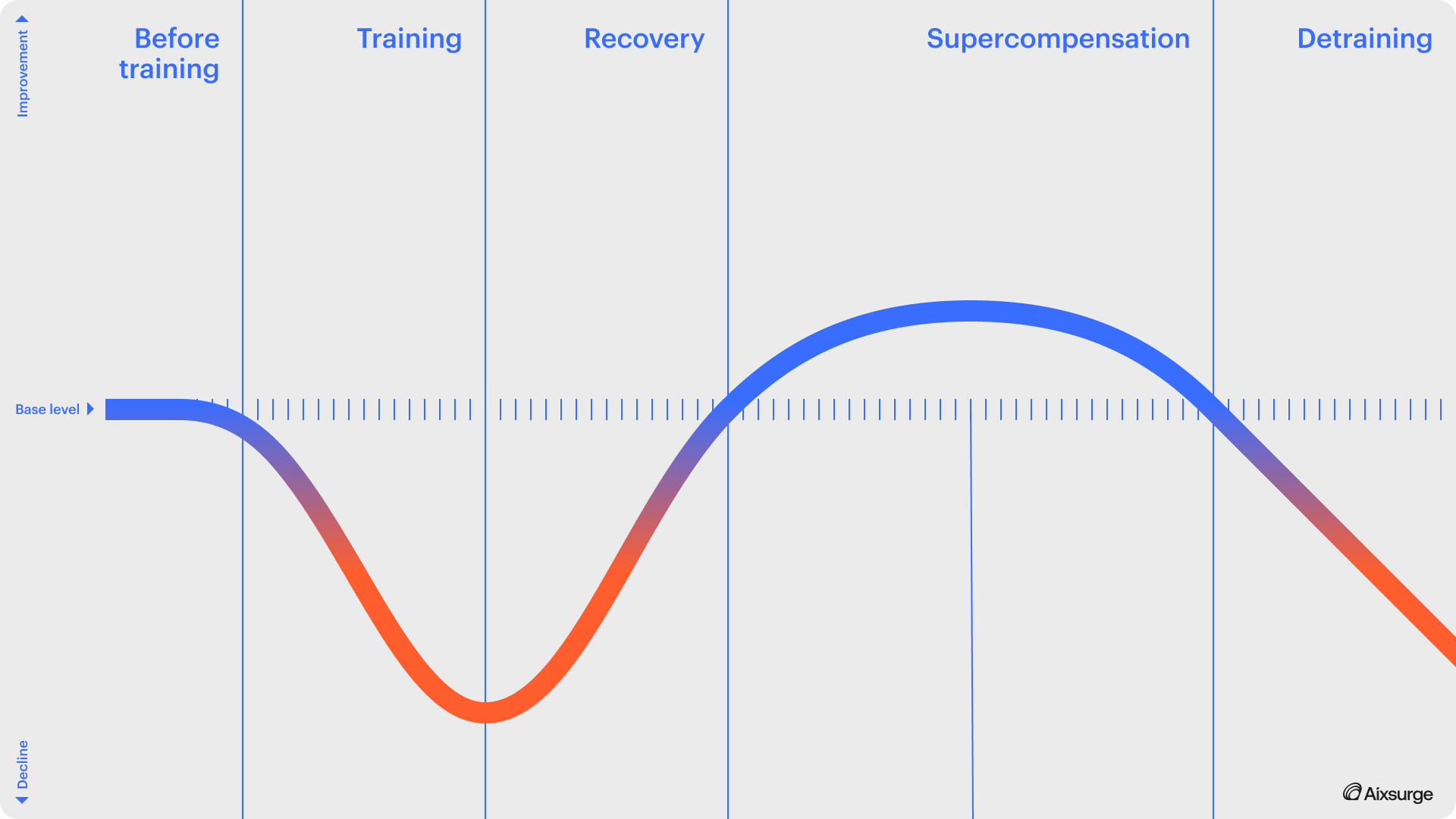
Try to increase training volume (duration) when decreasing training intensity. If that’s not possible because you’re time-crunched, you’re probably better off sticking to 2 interval sessions, as they will increase aerobic fitness too.
Base training FAQs
How long does it take to build up an aerobic base?
A typical aerobic base training block takes 6-12 weeks. If you’re totally new to endurance sports, building your first significant aerobic base can easily take 6-12 months. The truth is: when it comes to having an aerobic base, the bigger the better. As a result, building an aerobic base is never ‘done’. It’s a process that compounds over years.
How do I know if I have a good aerobic base?
You have a good aerobic base when you can comfortably do long training sessions. During those sessions you’ll notice your heart rate does not creep up (decouple) and you can continue to speak full sentences. Someone with a good aerobic base has a high aerobic threshold.
Is aerobic base the same as VO2 max?
Aerobic base is not exactly the same as VO2 max. When people talk about aerobic base, they usually refer to how well your aerobic energy system works during long slow distance exercise. VO2max on the other hand, is the ceiling of your aerobic energy system (at high intensities).
However, they are clearly highly related. It’s very unlikely an athlete has a good aerobic base, but a low VO2max (or the other way around). And yes, aerobic base training does increase VO2max.
Aerobic base vs Aerobic capacity vs Anaerobic base
We’ve got a full article about aerobic capacity and anaerobic capacity. Terms that are often used incorrectly.
How long should you exercise (in zone 2) to build an aerobic base?
Aerobic base training accumulates, so it’s total volume that matters, not any single session. You can run 30 minutes daily, or stack two longer sessions a week. There’s no minimum session length. That said, longer sessions do carry an extra benefit: time spent at the end of a workout, when you’re already tired, adds to the training effect. So mix in longer efforts when you can. Beyond that, the rule is simple: provided you recover between sessions, more is better.
Literature
High intensity training increases muscle’s oxidative capacity and aerobic power just like long slow distance training (LSD). Often even in a more time-efficient way.
- Burgomaster, Kirsten A et al. “Similar metabolic adaptations during exercise after low volume sprint interval and traditional endurance training in humans.” The Journal of physiology vol. 586,1 (2008): 151-60. doi:10.1113/jphysiol.2007.142109
https://pubmed.ncbi.nlm.nih.gov/17991697/
Traditional periodization (first: low-intensity, high-volume, then: high-intensity, low-volume) is as effective as reversed periodization.
- González-Ravé JM, González-Mohino F, Rodrigo-Carranza V, Pyne DB. Reverse Periodization for Improving Sports Performance: A Systematic Review. Sports Med Open. 2022 Apr 21;8(1):56. doi: 10.1186/s40798-022-00445-8. PMID: 35445953; PMCID: PMC9023617.
https://pmc.ncbi.nlm.nih.gov/articles/PMC9023617/
Running and swimming performance improved equally in traditional vs reversed periodization.
- Clemente-Suárez, Vicente Javier, and Domingo Jesús Ramos-Campo. “Effectiveness of Reverse vs. Traditional Linear Training Periodization in Triathlon.” International journal of environmental research and public health vol. 16,15 2807. 6 Aug. 2019, doi:10.3390/ijerph16152807
https://pubmed.ncbi.nlm.nih.gov/31390818/
Generalized zone 2 prescriptions based on %HRmax do not adequately account for interindividual variability.
- Meixner B, Filipas L, Holmberg HC, Sperlich B. Zone 2 Intensity: A Critical Comparison of Individual Variability in Different Submaximal Exercise Intensity Boundaries. Transl Sports Med. 2025 Feb 23;2025:2008291. doi: 10.1155/tsm2/2008291. PMID: 40225831; PMCID: PMC11986187.