
Full Distance Triathlon Nutrition Plan: How Many Carbs Per Hour to Fuel an Ironman
A proper Ironman nutrition plan is the difference between surviving the marathon and racing it. At 8-15 hours, nutrition is not a detail, it is the fourth discipline. This article tells you exactly how many carbs you need per hour, what to eat, how much to drink, and how to carry it all. Spoiler: the nutrition plan depends on your performance level and whether your goal is to race or to finish.
How many calories does a full IRONMAN burn
Before we build a full distance triathlon nutrition plan, it’s interesting to understand what’s at stake energetically. An Ironman is a serious metabolic event.
Research on full Ironman triathletes gives us useful insights: an Ironman burns approximately 10,036 kcal in male and 8,570 kcal in female triathletes.
This is based on an average finish time of 12h (male) and 12h 36m (female). Interestingly, triathletes burn far fewer calories in the swim portion of the race, compared to the bike or run.
|
Male |
Female |
|
|
Swim |
768 kcal |
737 kcal |
|
Bike |
5384 kcal |
4683 kcal |
|
Run |
3875 kcal |
3079 kcal |
|
Total |
10036 kcal |
8570 kcal |
|
Finish time |
12.0 hours |
12.6 hours |
Of course your race duration determines how many calories you burn. But so does intensity. Duration and intensity can cancel each other out, to some degree. According to this paper, the 8h finisher burns more calories than the 9h finisher, because of the higher exercise intensity. However, their theoretical model expects a 13h finisher to burn more than the 8 and 9 hour finishers, despite intensity being much lower:
|
Elite |
Top amateur |
Lower amateur |
|
|
Swim |
1094 kcal |
1094 kcal |
1094 kcal |
|
Bike |
4959 kcal |
4580 kcal |
6133 kcal |
|
Run |
3572 kcal |
3288 kcal |
3198 kcal |
|
Total |
9626 kcal |
9062 kcal |
10,425 kcal |
|
Finish time |
8:04:07 |
9:05:46 |
13:02:13 |
But more importantly: you cannot — and should not — try to replace all of those calories during your Ironman. For example, the triathletes in the first study only ate 35-40% of the calories burned. The Ironman athletes consumed 3940 kcal (male) and 3115 kcal (female).
This brings us to the key point: calories are not the right metric to guide your race-day nutrition. Full distance triathlon fueling is about something else.
Full distance IRONMAN (140.6) fueling
Theoretically all people have enough energy stored in the body to complete a full distance triathlon, without nutrition. A 75kg person with 15% body fat has 11kg of fat stored in the body. That equals 99,000 kcal, roughly 10x the energy required to finish an Ironman. Even a 60kg person with 5% body fat still has 2.5x the energy required.
So why even bother talking about fueling for an Ironman?
Because as soon as you increase intensity slightly — e.g. from walking to jogging — your body increasingly relies on carbohydrates as fuel. You cannot only burn fat. In fact, at lactate threshold intensity, fat contribution becomes negligible.
Luckily, you’re not going to race your Ironman at lactate threshold, meaning you will be burning fat. But even though being able to burn as much fat as possible during your Ironman is crucial, it’s clear that from a fueling perspective, we do not need to worry about fat intake.
So what to focus on instead? Scientists estimate that during a full Ironman, carbohydrates account for roughly 60% of total energy expenditure. Note that this carb contribution is significantly lower than in a half Ironman (70.3), meaning fat plays a bigger role in a full 140.6. Yet, the total amount of carbohydrates burned is (of course) much higher.
Here’s how much fat and carbohydrates (CHO) a recreational triathlete burned during the Ironman World Championship:
|
Segment |
Time |
CHO (g) |
Fat (g) |
|
Swim |
01:15:51 |
141 |
27 |
|
Cycle |
05:19:40 |
925 |
156 |
|
Run |
03:55:29 |
288 |
161 |
|
Total |
10:40:16 |
1370 |
348 |
This IRONMAN burned 348 grams of fat and 1370 grams of carbohydrates. Source: Metabolic profile of the Ironman World Championships: a case study
Unfortunately — unlike fat — your carbohydrate stores are limited. Depending on your pre-race nutrition and your race intensity, you could empty your carb stores within an hour. Which would result in a DNF.
This is why carbohydrates — not total calories or fat — are the central focus of long distance triathlon nutrition. Getting your carbohydrate intake right is what keeps you at race pace and prevents bonking during the run. So how many carbohydrates do you need during an Ironman?
How much carbohydrates do you need during the race
The full Ironman case study shows that a recreational triathlete burns roughly 150 gram carbs during the swim, 900 gram carbs during the bike and 300 gram carbs during the run segment. That sums up to almost 1400 gram carbs during the entire Ironman.
This triathlete finished the Ironman in 10:40:16 (hh:mm:ss), which resulted in a carbohydrate oxidation rate of about 130 grams per hour. That equals more than 5 bananas… per hour.
The good news: you don’t need to consume carbohydrates at the same rate. That is because a significant part of those carbohydrates can come from your carbohydrate storage in the muscles, also known as glycogen. You can boost glycogen levels with the right pre-race nutrition and a pre-race taper week.
So how many carbohydrates you need to consume during your Ironman depends on how much carbohydrates you burn and how much carbohydrates you have stored in the muscles:
Required carb intake = Carbs burned — Carbs stored (glycogen)
Numbers from the use case:
-
Carbs burned: 1370 grams
-
Carbs consumed during bike and run: 632 gram (70g per hour)
-
Carbs coming from carb storage: ~700 gram
There are two important things we can learn from this:
-
If you race faster (= burn more carbs), you need more glycogen or carb intake
-
If you increase carb intake or glycogen, you can theoretically race faster
Really? Race faster by consuming more carbohydrates?
This study shows that during IRONMAN Kona, Hawaii, faster finish times are correlated with higher carbohydrate intake rates.
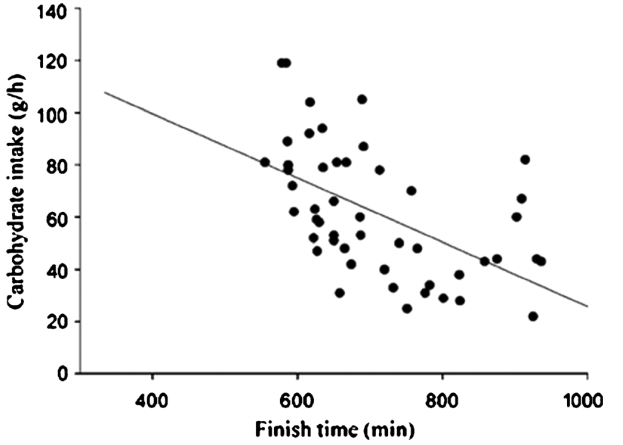
So should you simply implement the >100 grams of carbohydrate per hour from this graph, during your Ironman? Probably not. Here’s what to do instead.
How many grams of carbs per hour
A full triathlon (Ironman distance) typically takes between 8 and 15 hours to complete. That puts it firmly in the category of ultra-endurance exercise. Science gives us a clear target. If you want to race an Ironman as fast as possible, you should consume up to 90 grams of carbohydrate per hour.
Depending on your preferred foods — which we talk about in a minute — that equals roughly:
-
3-4 gels, OR;
-
1-2 gels and one 0.5L sports drink, OR;
-
1 energy bar and 2 gels
Even though some professionals consume up to 120 grams per hour on the bike, recreational triathletes should be cautious. Consuming more than 50-60g carbs per hour requires a well thought out strategy.
Moreover, research shows the carbohydrate demand for an Ironman can differ a lot between athletes. For instance, elite triathletes might burn 200 gram carbs per hour during an Ironman, while amateurs might burn less than 100 gram carbs per hour. And again, there’s no need to replace them all during the race, since you have carbs stored in the body.
It’s hard to know beforehand how much you will burn, but the following guidelines per sport will most certainly help. Also, continue reading about the importance of timing, intake vs uptake and carbohydrate types.
How many carbs per hour during the swim (3.8 km)
Many triathletes consume a gel just before the start of the swim, since you cannot fuel during the swim.
The swim leg of an Ironman typically takes 60-90 minutes, depending on your level. We saw you roughly burn 150g carbs during the swim. These need to come entirely from the energy storage you built through pre-race nutrition.
When the swim is over, it’s time to start fueling as soon as possible. That is especially true, because it takes time before carbohydrates enter the working muscle.
How many carbs per hour cycling (180 km)
Cycling provides the best opportunity to ingest carbohydrates during a triathlon. Most of the carbohydrate intake during a full triathlon race occurs during the cycling leg, with intake during the bike 2-3x higher than during the run.
The reason is straightforward: you can easily carry bottles, gels and other foods + you’re in a stable position, making food intake and gastric emptying easier compared to the run. It should be clear that missing your carb targets on the bike cannot be compensated for during the run.
Aim to take 90 grams of carbohydrates per hour when cycling. But only if:
-
You’ve experimented with this high intake during training
-
Your nutrition is a mix of glucose and fructose (2:1)
-
You’re racing at a high intensity
(More about these requirements in a bit)
If you don’t check all 3 boxes, 50-60 grams per hour is much more realistic.
So what do others do? Precision hydration looked at 137 case studies and found that on average, Ironman athletes consume 96 g of carbohydrate per hour during the cycling leg.
“On average, Ironman athletes consume 96 g of carbohydrate per hour during the cycling leg.”
They also found a lot of individual differences though, ranging from only 37 to 130 grams per hour during the entire Ironman. This emphasises again that your full Ironman nutrition plan depends on your performance level and whether your goal is to race or to finish.
One thing was very clear though: Ironman athletes “front-load” carbohydrates on the bike and consume less during the run.
How many carbs per hour running (marathon)
This is where many inexperienced Ironman triathletes go wrong. They either reduce carb intake to a minimum or push the same quantities they managed on the bike.
Contrary to a half Ironman, you need to keep carb intake fairly high. And since the running intensity is significantly lower than during a 70.3, maintaining carb intake is possible without GI distress.
So yes, you decrease intake compared to the cycling leg, but not a lot.
Aim to take 50-80 grams of carbohydrates per hour when running.
Precision hydration shows that the Ironman participants in their research still averaged 74g/h on the run. Which is only 23% less than during the bike segment.
Important note: your intake does not necessarily equal your uptake. Just because you can eat (swallow) 3 gels per hour doesn’t mean those carbohydrates actually enter your bloodstream. This is where choosing the right type of food comes into play. And equally important: training your gut. Let’s cover those topics next.
Full triathlon nutrition plan
Now that we know how many carbohydrates we need to consume, it’s time to talk about what exactly to eat and drink during your Ironman. We’ll cover:
-
What to eat
-
What to drink
-
Glucose: Fructose
-
Caffeine
Here’s your nutrition plan for a full Ironman:
What to eat during a full distance triathlon
Should you eat gels, bars or real food? Each carbohydrate source has its place in a long distance triathlon, and the right choice depends on where you are in the race.
Gels are compact, predictable, and easy to carry, making them the go-to choice for the run when solid food becomes difficult to tolerate. Given the marathon distance, practice taking gels consistently in training. Your gut needs to be accustomed to processing them for 3-5 hours.
Solid food is more relevant in a full Ironman than in a 70.3. At lower racing intensities over a longer duration, your gut can handle real food. Many athletes find it mentally easier to eat something solid after several hours on the bike. Bananas, rice cakes and boiled potatoes are popular choices at aid stations. However: keep fat, protein and fibre low, and stop taking solid food at least an hour before T2 to give your gut time to clear before the marathon.
The general rule: start with more variety on the bike, simplify aggressively as you approach and enter the run. And equally important: experiment in training, not on race day.
How often to take gel when running
A standard gel contains 20-25 grams of carbohydrates. To reach 50-80 grams of carbohydrates per hour, you need 2-3 gels per hour. In other words: take a gel every 20-30 minutes when running.
Most age-groupers run 3 to 5 hours during the marathon. That means you need to take about 8-12 gels in total. Practice this in training, so your gut is accustomed to it.
Also important: try to take gels with water, rather than a sports drink. Otherwise you’re increasing the carbohydrate concentration even further, which can slow absorption. If you are planning on taking sports drinks, adjust the number of gels and consider a less concentrated gel.
That brings us to the next topic.
What to drink during a full distance triathlon
Sports drinks kill two birds with one stone. They deliver carbohydrates and fluid simultaneously, making them ideal throughout the entire triathlon.
But how much should you drink?
Precision hydration looked at the hydration plan of 137 triathletes and found full IM athletes drank 865ml per hour during the cycling leg and 771ml per hour during the run. That’s significantly more than 70.3 athletes do. Especially on the run.
Isotonic vs Hypertonic vs Hypotonic
The concentration of carbohydrates in your sports drinks affects how quickly fluid is absorbed.
Isotonic drinks contain a carbohydrate concentration that is similar to the concentration of fluids in your body. This allows for a fairly quick uptake. Isotonic drinks are your go-to during a triathlon, balancing carbohydrate delivery and hydration.
Hypotonic drinks contain a lower carbohydrate concentration. They are absorbed even faster, but deliver fewer carbohydrates. They are useful when hydration is the priority, particularly in hot conditions.
Hypertonic drinks contain a higher carbohydrate concentration. Before they are absorbed, they need to draw water into the intestine to dilute the solution. This slows down the energy delivery and increases GI distress risk. Avoid relying on hypertonic drinks as your main fluid source during the race.
Gels are often hypertonic though. That’s actually practical: it allows you to carry a lot of carbohydrate in very little space. Always take them with water to aid absorption and reduce GI distress risk.
Electrolytes
When you sweat, you lose sodium. Replacing it helps your intestine absorb both water and carbohydrates more efficiently. Most isotonic sports drinks already contain sodium, so if you’re relying on these throughout the race you’re likely covered.
Hydration demands are significantly higher in a full Ironman than a 70.3. Expect to drink around 700-900ml per hour on the bike and maintain that through the run (yes this can be far more than you expected).
The hyponatraemia risk (sodium dropping too low) is also more serious at full distance. Slower athletes on course for 12-15 hours who drink large amounts of water without replacing sodium are most at risk. If you’re drinking mostly water rather than isotonic drinks, add electrolyte tablets throughout the race.
For hydration, aim to limit body weight loss through sweat to no more than 2-3% during the race. Weigh yourself before and after long training sessions to understand your personal sweat rate. At full Ironman duration, individual differences in sweat loss become much more consequential than at 70.3.
Glucose: Fructose
Not all carbohydrates are equal during exercise.
Glucose is absorbed via a transporter that maxes out at around 60 grams per hour. Once that transporter is saturated, extra glucose simply isn’t absorbed. It sits in your gut and increases the risk of gastrointestinal problems.
But we are aiming for 90 grams per hour when cycling.
That’s where fructose comes in. Fructose uses a completely different transporter. As a result, combining glucose and fructose allows you to increase carb intake from 60g (only glucose) to 90g per hour.
In practice, check the label on your gels and sports drinks to see whether they only contain glucose, or also fructose. A glucose-to-fructose ratio of 2:1 is recommended.
Caffeine
Looking for the most effective legal performance enhancer? Search no further. Caffeine is a well-researched and legal performance enhancer. It reduces your perception of effort, which is especially useful in the latter stages of an Ironman.
While 70.3 athletes typically consume most caffeine on the bike and less during the run, full Ironman athletes do the opposite. They increase caffeine intake from around 167mg on the bike to around 177mg during the marathon. This makes physiological sense: caffeine takes roughly 45 minutes to peak in the bloodstream, so while caffeine intake during the run is a bit late for a half marathon (70.3) it’s great timing for a full marathon (140.6).
In practice, save your highest caffeine gels or shots for the second half of the run, not the start of the bike. And as with all nutrition: test your caffeine strategy in training before race day. Caffeine affects athletes differently, and the last thing you need is an upset stomach at kilometre 30 of the marathon.
Making nutrition part of your IRONMAN training
In a way, your gut is like your muscles: it is highly adaptable. Research shows that both gastric emptying as well as stomach comfort can be trained. Adaptations that occur appear to be nutrient specific. Regularly consuming carbohydrates during training increases the capacity of intestinal transporters.
In practice: don’t save your race nutrition for race day. Use your long training sessions to systematically increase your carbohydrate intake, starting at 40-50g per hour and building toward your race target over several weeks.
FAQ: How to avoid GI problems during your full distance triathlon
Research shows that 31% of Ironman athletes have serious GI symptoms (compared to 14% in 70.3). The most important risk factors are ones you can control. Avoid GI problems by avoiding high carbohydrate intake without gut training, hypertonic drinks, and consuming fibre, fat or protein during the race.
Minimise the risk of experiencing GI problems by keeping race nutrition simple: isotonic drinks, gels with water and no solid foods in the final hour before T2. Equally important: train your gut systematically in the weeks before the race. Never try anything new on race day.
Literature
An Ironman burns approximately 10,036 kcal in male and 8,570 kcal in female triathletes.
- Kimber, Nicholas E et al. “Energy balance during an ironman triathlon in male and female triathletes.” International journal of sport nutrition and exercise metabolism vol. 12,1 (2002): 47-62. doi:10.1123/ijsnem.12.1.47 https://pubmed.ncbi.nlm.nih.gov/11993622/
An 8h finisher burns more calories than the 9h finisher, because of the higher exercise intensity.
- Maunder, Ed et al. “Substrate Metabolism During Ironman Triathlon: Different Horses on the Same Courses.” Sports medicine (Auckland, N.Z.) vol. 48,10 (2018): 2219-2226. doi:10.1007/s40279-018-0938-9 https://pubmed.ncbi.nlm.nih.gov/29777386/
An IRONMAN burned 348 grams of fat and 1370 grams of carbohydrates.
- Cuddy, John S et al. “Metabolic profile of the Ironman World Championships: a case study.” International journal of sports physiology and performance vol. 5,4 (2010): 570-6. doi:10.1123/ijspp.5.4.570 https://pubmed.ncbi.nlm.nih.gov/21266741/
During IRONMAN Kona, Hawaii, faster finish times are correlated with higher carbohydrate intake rates.
- Pfeiffer, Beate et al. “Nutritional intake and gastrointestinal problems during competitive endurance events.” Medicine and science in sports and exercise vol. 44,2 (2012): 344-51. doi:10.1249/MSS.0b013e31822dc809 https://pubmed.ncbi.nlm.nih.gov/21775906/
If you want to race an Ironman as fast as possible, you should consume up to 90 grams of carbohydrate per hour.
- Jeukendrup, Asker E. “Nutrition for endurance sports: marathon, triathlon, and road cycling.” Journal of sports sciences vol. 29 Suppl 1 (2011): S91-9. doi:10.1080/02640414.2011.610348 https://pubmed.ncbi.nlm.nih.gov/21916794/
The carbohydrate demand for an Ironman can differ a lot between athletes.
- Maunder, Ed et al. “Substrate Metabolism During Ironman Triathlon: Different Horses on the Same Courses.” Sports medicine (Auckland, N.Z.) vol. 48,10 (2018): 2219-2226. doi:10.1007/s40279-018-0938-9 https://pubmed.ncbi.nlm.nih.gov/29777386/
Most of the carbohydrate intake during a full triathlon race occurs during the cycling leg.
- Jeukendrup, Asker E et al. “Nutritional considerations in triathlon.” Sports medicine (Auckland, N.Z.) vol. 35,2 (2005): 163-81. doi:10.2165/00007256-200535020-00005 https://pubmed.ncbi.nlm.nih.gov/15707379/
Both gastric emptying as well as stomach comfort can be trained.
- Jeukendrup, Asker E. “Training the Gut for Athletes.” Sports medicine (Auckland, N.Z.) vol. 47, Suppl 1 (2017): 101-110. doi:10.1007/s40279-017-0690-6 https://pubmed.ncbi.nlm.nih.gov/28332114/
31% of Ironman athletes have serious GI symptoms.
- Pfeiffer, Beate et al. “Nutritional intake and gastrointestinal problems during competitive endurance events.” Medicine and science in sports and exercise vol. 44,2 (2012): 344-51. doi:10.1249/MSS.0b013e31822dc809 https://pubmed.ncbi.nlm.nih.gov/21775906/
Jump straight to: