
How to Calculate your Lactate Threshold in Swimming, Cycling and Running - using threshold tests
Triathletes know: lactate threshold pace or power is the key to unlocking personalized training zones and pacing strategies. However, not all threshold tests are equally accurate. Let’s have a look at several anaerobic threshold tests in swimming, cycling and running. Spoiler: you don’t need an expensive lab to accurately estimate lactate threshold!
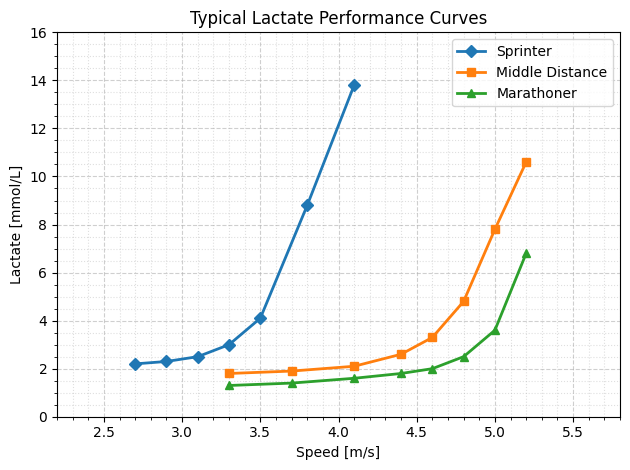
What is your Anaerobic Lactate Threshold?
The anaerobic threshold (AT) or lactate threshold (LT) is the highest exercise intensity at which your blood lactate concentration does not increase or decrease. Hence it is also known as the maximal lactate steady state (MLSS).
Instead of lactate threshold pace or power (this article), you can also calculate your lactate threshold heart rate.
In training, triathletes use this intensity to determine training zones and track progress.
In triathlon races, the lactate threshold is often used as a key marker to avoid exceeding, as going above threshold can quickly lead to fatigue. Additionally, exercising above threshold significantly increases carbohydrate consumption — a precious fuel source — which is considered sub ideal in long-distance events.
In summary, accurately estimating your lactate threshold helps to:
- Set precise training zones
- Track fitness progress over time
- Pace triathlon races
How to accurately estimate lactate threshold
The gold standard test to measure lactate threshold is the maximal lactate steady state (MLSS) test. It requires athletes to do several 30 minute all out tests with blood lactate samples. The goal is to find the highest intensity at which blood lactate concentration does not increase during the last part of the test.
This threshold test is time consuming and interferes with a training program. Especially if you want to do the protocol for swimming, cycling and running. Hence, no triathlete or coach will do these tests on a regular basis.
That is also not necessary, because there are many threshold tests that estimate lactate threshold. Each sport (swimming, cycling, running) has its own threshold test protocols with corresponding threshold calculations.
Before we dive into those tests and ways to calculate threshold, it’s important to understand that not all ‘threshold test results’ are interchangeable. For instance, the famous Critical Swim Speed (CSS) test is known to overestimate a 30 minute velocity swim test by more than 3%, which in turn overestimates maximal lactate steady state by more than 5%.
In this anaerobic threshold test overview, we will not only share threshold test protocols and calculations, but also how they compare to the gold standard MLSS tests — according to scientific literature. This is crucial when accurately estimating lactate threshold.
Jump straight to:
- Swimming tests to estimate threshold
- Cycling tests beyond functional threshold power
- Running tests to calculate lactate threshold pace
Swimming tests to estimate anaerobic threshold
Let’s look at the 3 most common swim tests to estimate lactate threshold:
Critical swim speed test
The critical swim speed (CSS) test is a common swim test. It requires two max efforts, and looks at how swim speed decreases when distance increases. Mathematically, critical swim speed is defined as the intensity that could be maintained indefinitely without exhaustion. It therefore aims to identify a very similar intensity than the gold standard: maximal lactate steady state (MLSS).
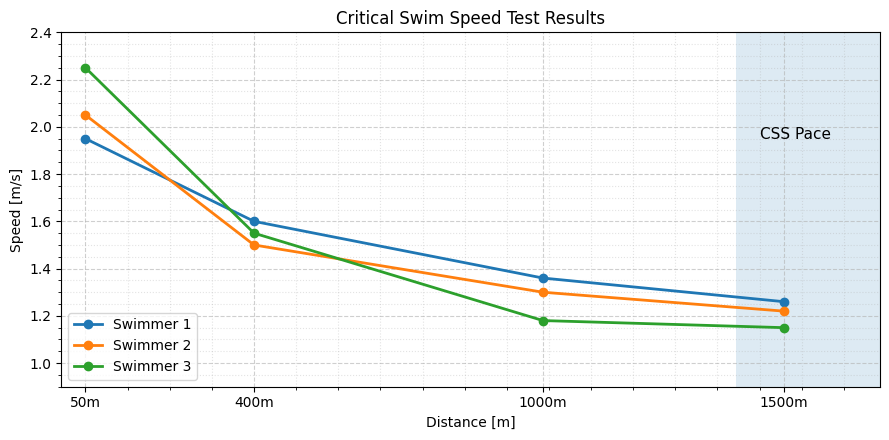
Literature shows that critical swim speed slightly overestimates MLSS by 5.3%. So although this swim test is a good way to estimate lactate threshold, you should subtract 5.3% of the critical swim speed, to get the lactate threshold pace.
Protocol
Perform a warm up. For example: 10 easy minutes with some short accelerations.
- Swim 400m as fast as you can (max effort at steady pace)
- At least 15 minutes of recovery or next day
- Swim 200m as fast as you can (max effort at steady pace)
Cool down. For example: 10 minutes easy
Calculation
Here’s the formula to calculate your critical swim speed based on the test:
Critical swim speed in m/s = (D2 — D1) / (t2 — t1)
With:
- D1 = distance of shorter swim trial (e.g. 200 m)
- t1 = time (in seconds) for shorter trial
- D2 = distance of longer swim trial (e.g. 400 m)
- t2 = time (in seconds) for longer trial
⚠️ As mentioned, subtract 5.3% from your critical swim speed to estimate your lactate threshold swim speed.
30 minute swim test
The 30 minute swim test is often used by elite swim coach Jan Olbrecht. You could say Olbrecht developed this test. There’s no direct comparison study between this 30 minute swim test and the gold standard MLSS. However, we can draw conclusions based on these two studies:
- Critical swim speed is 3.2% higher than 30 minute velocity (study)
- Critical swim speed is 5.3% higher than maximal lactate steady state (study)
As a result, we can conclude that your 30 minute swim pace is probably roughly 2% higher than MLSS. So although this swim test is a good way to estimate lactate threshold, you should subtract 2% of your 30 minute swim pace, to get the lactate threshold pace.
Protocol
Perform a warm up. For example: 10 easy minutes with some short accelerations.
- Swim 30 minutes as fast as you can (max effort at steady pace)
Cool down. For example: 10 minutes easy
Calculation
To get your 30 minute swim pace, simply take the average pace of your 30 minute swim.
⚠️ As mentioned, subtract 2% from your 30 minute swim pace to estimate your lactate threshold swim speed.
1000m T-pace swim test
In his popular book “The Triathlete’s Training Bible”, Joe Friel describes his 1000m swim test, which should result in your threshold pace (T-pace).
So far, there’s no scientific literature available to compare a 1000m swim test with the gold standard maximal lactate steady state (MLSS). By definition a 1km all-out effort is above anaerobic threshold.
Assuming this swim test duration is shorter than your 30 minute swim test, it is fair to assume your 1000m T-pace is roughly 5% higher than a true MLSS.
Protocol
Perform a warm up. For example: 10 easy minutes with some short accelerations.
- Swim 1000m as fast as you can (max effort at steady pace)
Cool down. For example: 10 minutes easy
Calculation
To get your T-pace, simply divide your test duration by 10 to get swim pace per 100 meter.
⚠️ As mentioned, subtract 5% from your 1000m T-pace to estimate your lactate threshold swim speed.
Cycling threshold tests beyond FTP
The popular Functional Threshold Power (FTP) test is only one of many options out there, to estimate your lactate threshold power.
Let’s look at the 3 most common cycling threshold tests you can do without visiting a lab:
Critical Power (CP) test for cyclists
The critical power (CP) test is a common cycling test. Similar to the critical swim speed test, it requires at least two max efforts. The critical power test is based on the relationship between power and duration: the longer the duration the lower the sustainable power. This becomes extra clear when plotting all-out efforts of different lengths. A clear power-duration curve emerges.
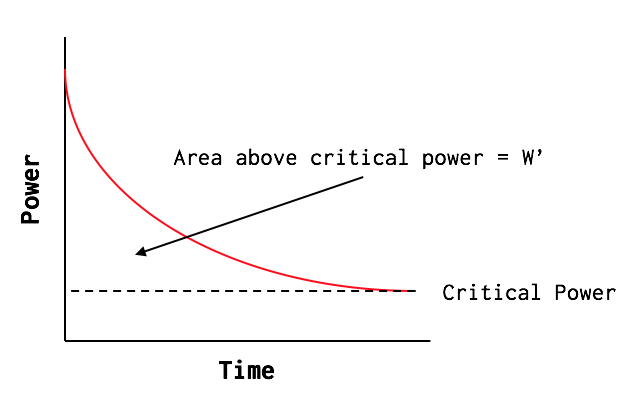
Mathematically, critical power is defined as the intensity that could theoretically be maintained indefinitely (at the far end of the power duration curve). It therefore aims to identify a very similar intensity than the gold standard: maximal lactate steady state (MLSS).
On average, literature shows that critical power overestimates MLSS by 7%. So although this CP test is a good way to estimate lactate threshold, you should subtract 7% of the result, to get the lactate threshold power.
Protocol
Perform a warm up. For example: 10 easy minutes with some short accelerations.
- 3-5 minutes as fast as you can (max effort at steady power)
- At least 15 minutes of recovery or next day
- 12-20 minutes as fast as you can (max effort at steady power)
Cool down. For example: 10 minutes easy
Calculation
Here’s the formula to calculate your critical power based on the test:
Critical power = (P2*t2 — P1*t1) / (t2 — t1)
With:
- P1 = mean power (in watts) from the shorter-duration maximal effort (e.g. 3–5 min)
- t1 = duration (in seconds) of that shorter effort
- P2 = mean power (in watts) from the longer-duration maximal effort (e.g. 12-20 min)
- t2 = duration (in seconds) of that longer effort
Note that if you performed the cycling FTP test with a 5 min and a 20 min max effort, you can use those efforts to calculate Critical Power.
⚠️ As mentioned, subtract 7% from your critical power to estimate your lactate threshold power.
Cycling RAMP test outside a lab
Most exercise performance labs use RAMP or incremental step tests to determine the lactate threshold. During such a test, you start at an easy intensity and slowly increase it step by step.
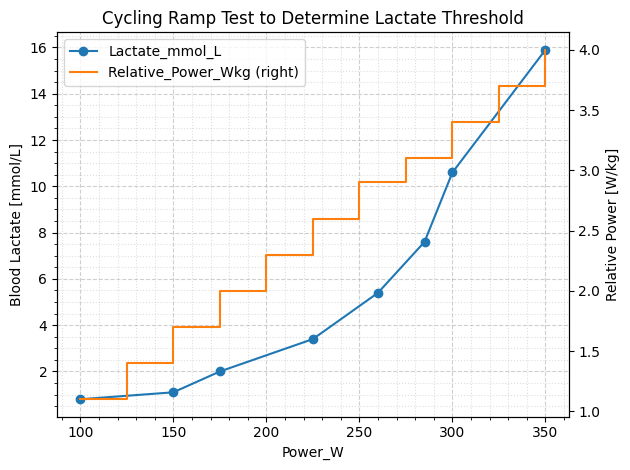
In laboratory settings, these tests are paired with equipment like metabolic carts or lactate analyzers to precisely identify physiological thresholds. However, cyclists can estimate the anaerobic threshold using a power meter and an indoor trainer only.
Ideally this cycling threshold test is performed in ERG mode on a trainer, using the same power meter as in training. For convenience, it’s best to perform a ramp test using an app like Aixsurge. The app walks you through the protocol and calculates your lactate threshold.
Protocol
Perform a warm up. For example: 10 easy minutes with some short accelerations.
- Start riding your bike at 100 watts. Increase power by 20 watts each minute. Stay seated, keep a steady cadence, and keep ramping up until you simply cannot continue.
Cool down. For example: 10 minutes easy
Calculation
To estimate the anaerobic threshold power, take the highest average power over any 1-minute period, and multiply it by 0.75.
For instance: if you stopped the test halfway through a 240-watt step (after 30 seconds), and the previous step was at 220 watts, your highest 1-minute average power would be: 230 watts. (30 seconds at 220 W + 30 seconds at 240 W = 230 W average.) Your estimated threshold power than equals 230 * 0.75 = 172.5 W.
Unfortunately, there’s no scientific comparison available between this estimated threshold power and the gold standard MLSS. So use the estimate with caution, as a rough guideline for training.
Functional Threshold Power (FTP) test
The cycling FTP test needs no introduction. If you own a cycling power meter, you probably performed the test already. However, it seems like most triathletes and cyclists do not stick to the original FTP protocol nor do they use the right formula to calculate FTP based on the 20 minute test.
“Most athletes do not stick to the original FTP protocol nor do they use the right formula to calculate FTP.”
Both aspects are crucial for getting accurate threshold estimates. Science shows that if you perform a single 20 minute test and take the average power as your threshold, you will overestimate your lactate threshold power (MLSS) by about 13% on average, with individual overestimations reaching up to 18%.
Here’s how to perform and calculate FTP — the right way:
Protocol
Perform a warm up. For example: 10 easy minutes with some short accelerations.
- 5 minutes as fast as you can (max effort at steady power)
- 10 minutes easy recovery
- 20 minutes as fast as you can (max effort at steady power)
Cool down. For example: 10 minutes easy
The 5 minute effort is often neglected but is a key part of the protocol. As one of the ‘co-inventors’ of the protocol says: “This initial 5-minute effort helps to dispense the ‘freshness’ that always exists at the beginning of a ride; your next effort will produce power that is more likely to be truly representative of your FTP.”
Calculation
The functional threshold power equals the average power of your 20 minute interval, multiplied by 0.95. When using the described protocol, this will likely be a good estimate for your MLSS.
Running tests to calculate lactate threshold pace
If you want to calculate lactate threshold pace in running, you have several options.
Here are the 4 most common running threshold tests:
Critical Pace (CP) test for runners
The Critical Pace (CP) test is very similar to the critical swim speed test and the critical power test for cyclists. It requires at least two max efforts that can also be taken from historical training data.
The goal is to create a pace-duration curve, and look for the pace that could theoretically be maintained indefinitely (where duration is infinite).
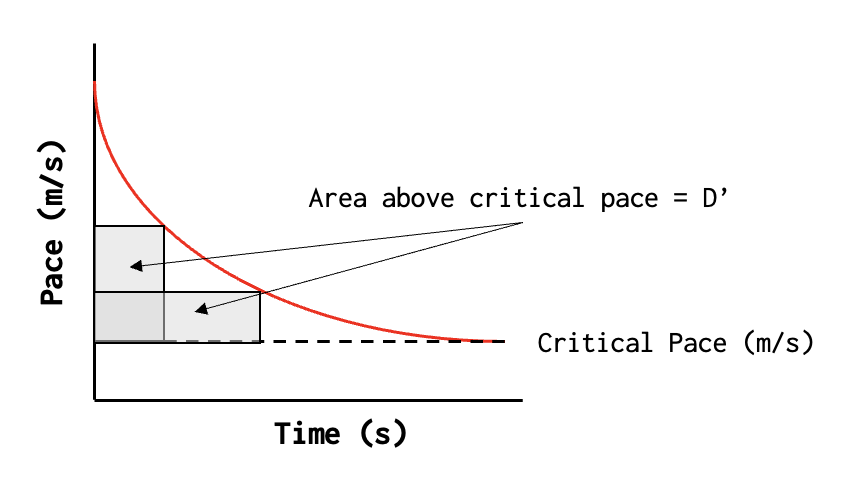
Critical pace aims to identify a very similar intensity than the gold standard anaerobic threshold: maximal lactate steady state (MLSS). We’ve already learned that critical swim speed (5.3%) and critical power (7%) overestimate MLSS. According to scientific literature, that is no different for the critical pace in running: 6%. So if you use this test to estimate MLSS, make sure to subtract 6% of the result, to get your lactate threshold pace in running.
Protocol
Perform a warm up. For example: 10 easy minutes with some short accelerations.
- 3-5 minutes as fast as you can (max effort at steady pace)
- At least 15 minutes of recovery or next day
- 12-20 minutes as fast as you can (max effort at steady pace)
Cool down. For example: 10 minutes easy
Calculation
Here’s the formula to calculate your critical pace based on the test:
Critical pace in m/s = (V2*t2 — V1*t1) / (t2 — t1)
With:
- V1 = mean speed (in m/s) from the shorter effort
- t1 = time (in seconds) of the shorter effort
- V2 = mean speed (in m/s) from the longer effort
- t2 = time (in seconds) of the longer effort
⚠️ As mentioned, subtract 6% from your critical pace to estimate your lactate threshold run pace.
Running RAMP test outside the lab
RAMP or incremental step tests are common run tests. These tests are often performed on a treadmill in the lab, or on a running track. During the test, you start to run at an easy pace and slowly increase the intensity step by step.
Maybe you’ve heard about lab tests with metabolic carts or field tests with lactate analyzers. These are ways to precisely identify the lactate threshold. But, you can also estimate your threshold using your GPS watch only.
A scientifically documented incremental running test is commonly used to predict endurance performance by measuring the peak running speed (Vpeak) achieved during the protocol. This test uses 3-minute stages, which are preferred in the scientific literature over shorter stages.
Although this test result (Vpeak) is highly related to the running velocity at lactate threshold, science shows it is 17.6% higher than the velocity at lactate threshold. So if you use this RAMP test to estimate MLSS, be sure to subtract 17.6% of the result, to get an estimate of your lactate threshold pace in running.
For your own convenience, it is recommended to run on a treadmill (use a 1% incline) or on a track when performing this test.
Protocol
Perform a warm up. For example: 10 minutes easy with some short accelerations.
- Run at 8 km/h. Increase velocity 1 km/h every 3 minutes. Keep ramping up until you simply cannot continue.
Cool down. For example: 10 minutes easy
Calculation
Peak running velocity (km/h) = Vcomplete + (Inc × t/T)
- Vcomplete = the running velocity (km/h) of the last complete stage
- Inc = the velocity increment = 1 km/h
- t = the number of seconds sustained during the incomplete stage
- T = the number of seconds required to complete a stage = 180 s
⚠️ As mentioned, subtract 17.6% from your peak running velocity to estimate your lactate threshold run pace.
30 minute run test
On to a more straightforward way of estimating your lactate threshold running pace: a 30 minute all-out test.
Scientific literature suggests that the average pace and heart rate of a 30-minute time trial run do not significantly differ from the lactate threshold pace and lactate threshold heart rate.
Protocol
WU: 10 minutes easy with some accelerations
- 30 minutes as fast as you can (max effort at steady pace)
CD: 10 minutes
5k run test
Another seemingly straightforward way to estimate running threshold pace is via a 5k run. This makes sense, because most runners and triathletes are familiar with doing a 5k race (in training).
However, there’s no clear scientifically validated formula that explains the relationship between your 5k performance and your anaerobic threshold pace.
Some coaches estimate threshold pace by simply adding a fixed amount—typically 5 to 25 seconds per kilometer—to your 5K race pace. Others use a percentage-based adjustment.
To stay on the safe side, estimate your threshold velocity (m/s) by subtracting 10% from your 5K race velocity.
Calculate training zones based on the anaerobic lactate threshold
You can use your anaerobic lactate threshold to calculate training zones. For instance:
Training zones for swimmers, based on lactate threshold (LT) speed:
|
Zone 1 |
Recovery |
89% — 91% LT |
|
Zone 2 |
Endurance |
92% — 94% LT |
|
Zone 3 |
Tempo |
95% — 98% LT |
|
Zone 4 |
Threshold |
99% — 106% LT |
|
Zone 5 |
Anaerobic / VO2max |
> 106% LT |
Training zones for cyclists, based on lactate threshold (LT) power:
|
Zone 1 |
Recovery |
40% — 55% LT |
|
Zone 2 |
Endurance |
56% — 75% LT |
|
Zone 3 |
Tempo |
76% — 90% LT |
|
Zone 4 |
Threshold |
91% — 105% LT |
|
Zone 5 |
Anaerobic / VO2max |
> 106% LT |
Training zones for runners, based on lactate threshold (LT) speed:
|
Zone 1 |
Recovery |
65% — 78% of LT |
|
Zone 2 |
Endurance |
78% — 88% LT |
|
Zone 3 |
Tempo |
88% — 94% LT |
|
Zone 4 |
Threshold |
95% — 103% LT |
|
Zone 5 |
Anaerobic / VO2max |
> 104% LT |
References
Critical swim speed slightly overestimates maximal lactate steady state, by 5.3%.
- Dekerle J, Pelayo P, Clipet B, Depretz S, Lefevre T, Sidney M. Critical swimming speed does not represent the speed at maximal lactate steady state. Int J Sports Med. 2005 Sep;26(7):524-30. doi: 10.1055/s-2004-821227. PMID: 16195984.
https://pubmed.ncbi.nlm.nih.gov/16195984/
Critical swim speed is 3.2% higher than 30 minute velocity.
- Dekerle J, Sidney M, Hespel JM, Pelayo P. Validity and reliability of critical speed, critical stroke rate, and anaerobic capacity in relation to front crawl swimming performances. Int J Sports Med. 2002 Feb;23(2):93-8. doi: 10.1055/s-2002-20125. PMID: 11842355.
https://pubmed.ncbi.nlm.nih.gov/11842355/
Critical power overestimates MLSS by 7%.
- Jones AM, Burnley M, Black MI, Poole DC, Vanhatalo A. The maximal metabolic steady state: redefining the 'gold standard'. Physiol Rep. 2019 May;7(10):e14098. doi: 10.14814/phy2.14098. PMID: 31124324; PMCID: PMC6533178.
https://pmc.ncbi.nlm.nih.gov/articles/PMC6533178/
The average power of a single 20 minute test overestimates MLSS by about 13%.
- Inglis EC, Iannetta D, Passfield L, Murias JM. Maximal Lactate Steady State Versus the 20-Minute Functional Threshold Power Test in Well-Trained Individuals: “Watts” the Big Deal? Int J Sports Physiol Perform. 2019 Nov 4;15(4):541-547. doi: 10.1123/ijspp.2019-0214. PMID: 31689684.
https://pubmed.ncbi.nlm.nih.gov/31689684/
Critical pace overestimates MLSS by 6%.
- de Lucas RD, Dittrich N, Junior RB, de Souza KM, Guglielmo LG. Is the critical running speed related to the intermittent maximal lactate steady state? J Sports Sci Med. 2012 Mar 1;11(1):89-94. PMID: 24149124; PMCID: PMC3737850.
https://pmc.ncbi.nlm.nih.gov/articles/PMC3737850/
3-min incremental steps are recommended in a running RAMP test.
- Machado FA, Kravchychyn AC, Peserico CS, da Silva DF, Mezzaroba PV. Incremental test design, peak 'aerobic' running speed and endurance performance in runners. J Sci Med Sport. 2013 Nov;16(6):577-82. doi: 10.1016/j.jsams.2012.12.009. Epub 2013 Feb 4. PMID: 23379988.
https://pubmed.ncbi.nlm.nih.gov/23379988/
Vpeak is related to the running velocity at lactate threshold, but it’s 17.6% higher.
- Peserico, Cecília & Alves, Júlio & Machado, Fabiana. (2021). Associations between Vpeak, vLT and 10-km running performance in recreational runners. Sport Sciences for Health. 17. 10.1007/s11332-020-00689-5.
https://www.researchgate.net/publication/344093366_Associations_between_Vpeak_vLT_and_10-km_running_performance_in_recreational_runners
The average pace and heart rate of a 30-minute time trial run do not significantly differ from the threshold pace and heart rate.
- McGehee JC, Tanner CJ, Houmard JA. A comparison of methods for estimating the lactate threshold. J Strength Cond Res. 2005 Aug;19(3):553-8. doi: 10.1519/15444.1. PMID: 16095403.
https://pubmed.ncbi.nlm.nih.gov/16095403/

Table of Contents