What is supercompensation, and how can it be applied in triathlon
Explore how the 4 phases of supercompensation in training work, and how to apply them in your triathlon training program.
January 29, 2025
20 mins to read
Supercompensation is the physiological process where the body adapts to training, by recovering to a state of enhanced performance, provided adequate recovery.
This principle, essential for all athletes, underpins how we should structure training cycles to balance stress and recovery for optimal performance.
At its core, supercompensation involves carefully timed phases of training and recovery. When executed correctly, athletes gain performance quickly. However, poor training management, e.g. via inadequate recovery or excessive training, can easily lead to under- or overtraining.
The concept of supercompensation was discovered in the mid-20th century, by physiologist Nikolai Yakovlev. He found that muscle energy (glycogen) exceeds baseline levels post-exercise recovery, following intense exercise and training. We now know that this supercompensation process comes in 4 phases.
Phases of Supercompensation
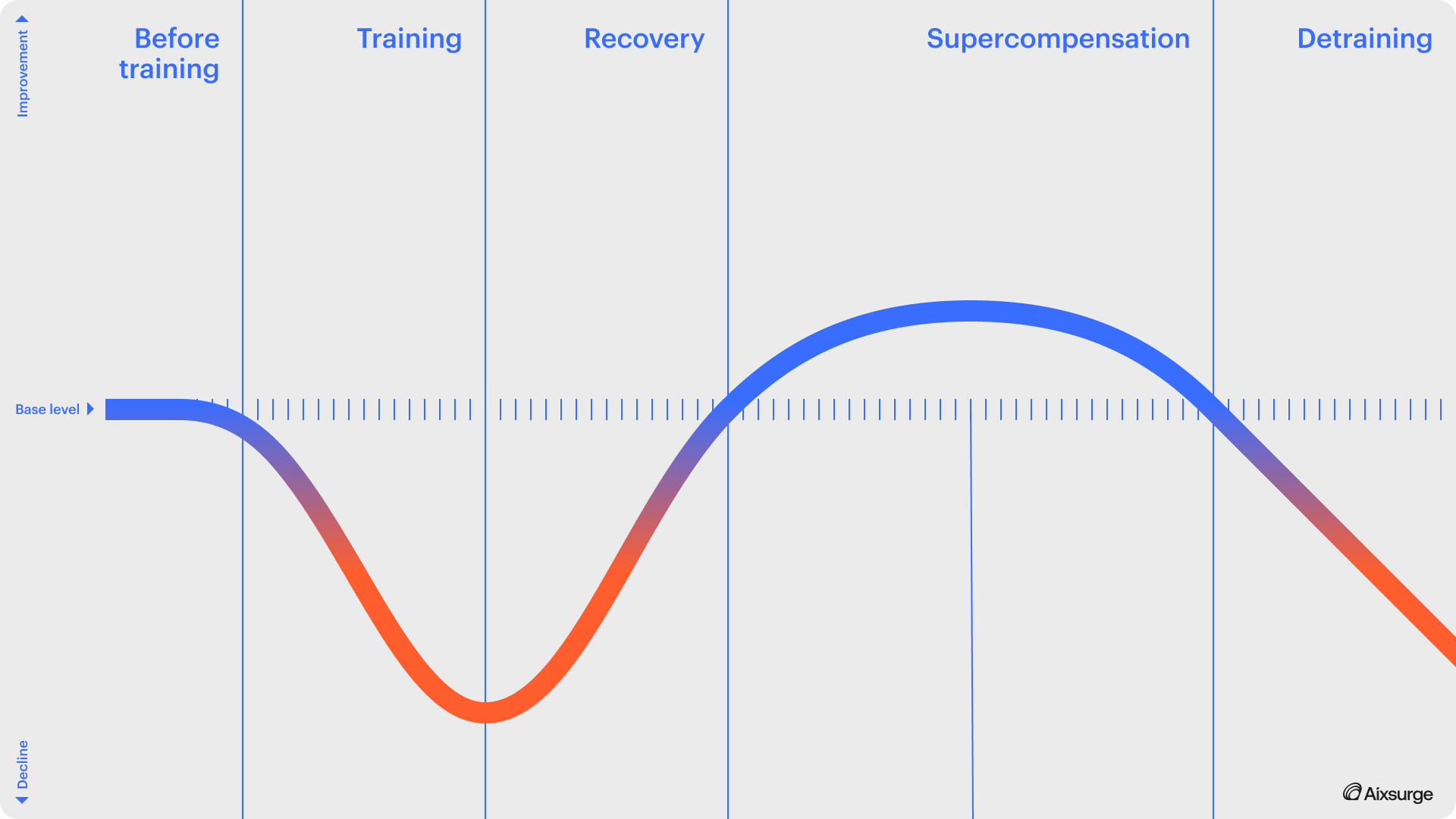
Supercompensation unfolds in four distinct phases, each playing a crucial role in transforming training stress into performance gains. Understanding these phases allows you to optimize your training cycles for maximum benefit. Let’s quickly summarize the phases:
Phase 1: Training equals performance decline
During training, your body is subjected to training stress. This stress causes fatigue, which will temporarily decrease your performance.
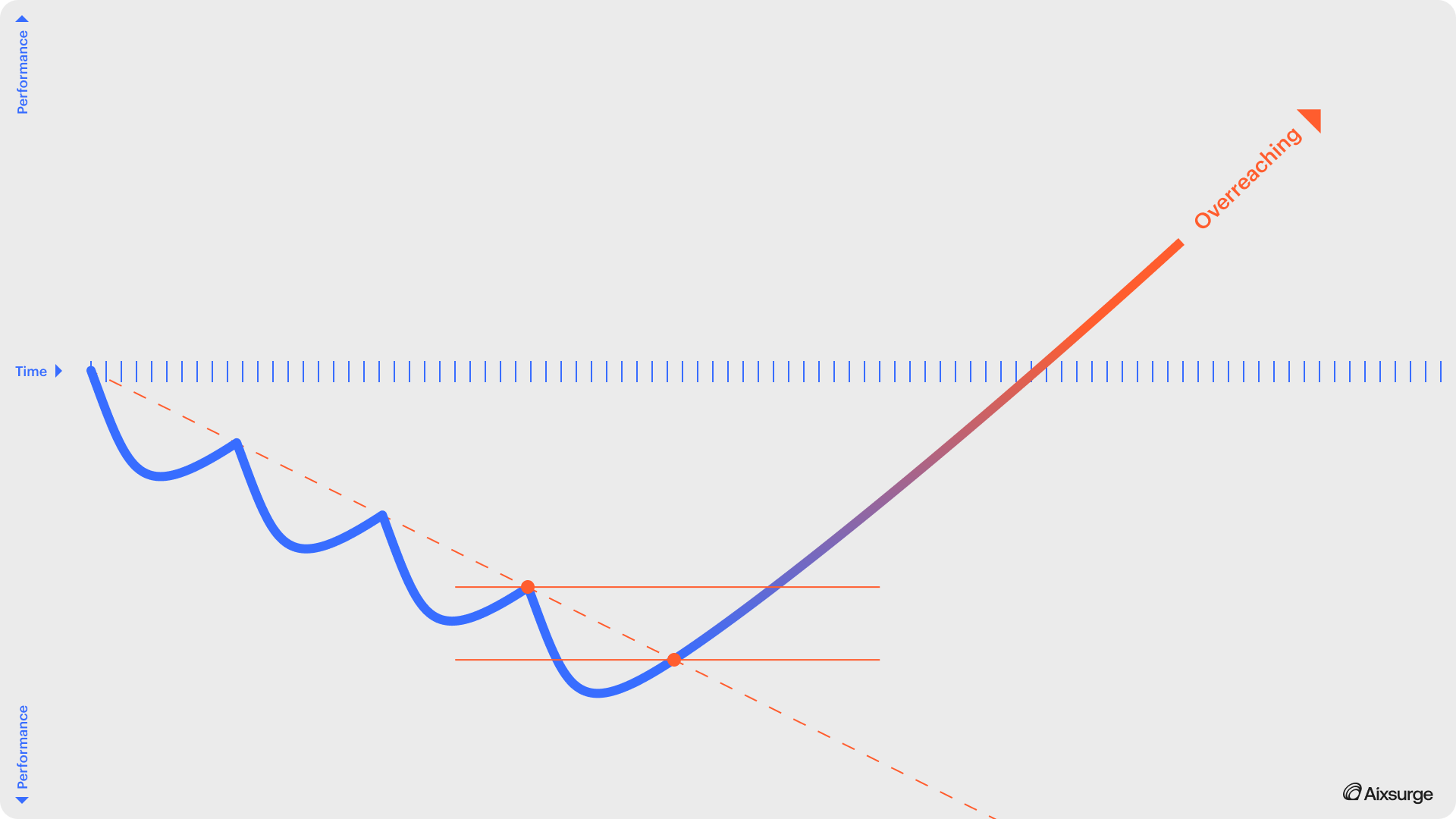
This phase is essential to signal the body that it needs to adapt. The goal is to apply enough stress to start an adaptation, without pushing too far into overreaching.
Phase 2: Recovery returns you to baseline
After finishing your workout, the body enters the recovery phase. Provided that you take rest and consume healthy foods, energy reserves are replenished, muscles are rebuilt, and hormonal balance is restored.
The duration of this recovery phase depends on many factors, which we will discuss in a bit.
At the end of phase 2, the body is back to where it was prior to training. It’s back to baseline.
Phase 3: Supercompensation
Phase 3 is where the magic happens. During supercompensation, your fitness is temporarily exceeding the original baseline. This is why you started training after all.
This is the optimal window for a new training session or key race. But be aware, supercompensation does not last forever!
Phase 4: Detraining
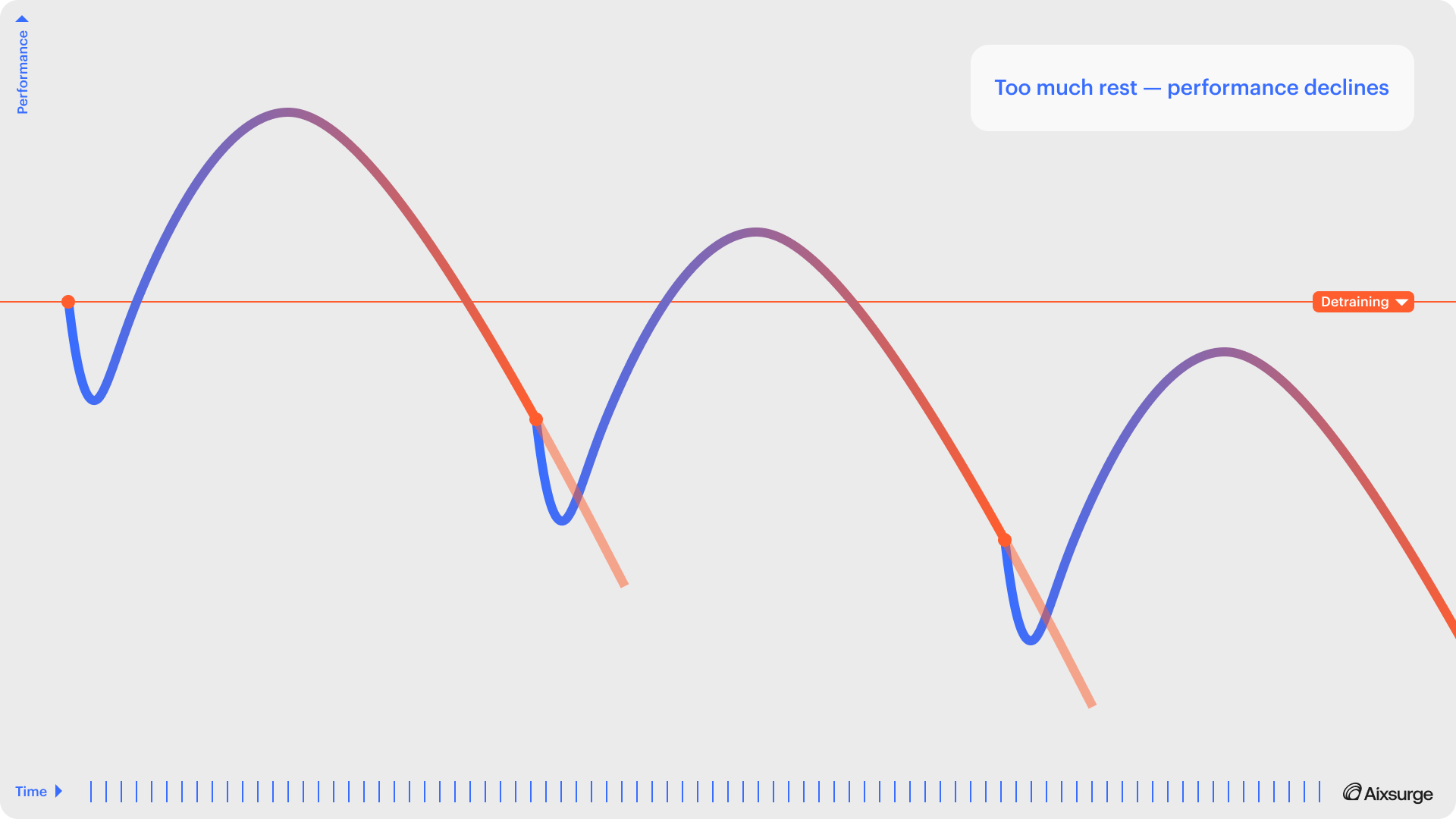
If you do not train during supercompensation, you’ll gradually return to your pre-training state.
In fact, prolonged inactivity can lead to detraining, undoing the gains achieved. According to literature, as little as 1 week of training cessation can already negatively affect muscle energy stores by 20%. VO2max is significantly decreased in less than 4 weeks of insufficient training.
That is why structured training cycles are essential to sustain and build upon supercompensation gains.
Key takeaway
Supercompensation is the result of a balance between training and recovery.
If you train too much or too hard, it’s hard to recover and supercompensation may never take place. If you train too little, your body is detrained before you start your next workout.
Recognizing the phases and timing your workouts accordingly maximizes performance gains and prevents under-over overtraining.
Timing of supercompensation: examples of recovery time
When putting the supercompensation theory into practice, knowing the time it takes to recover from a workout is crucial.
Three important factors that determine recovery time are:
The workout intensity and duration
The fitness level of the athlete
The recovery quality
Workout type vs recovery time
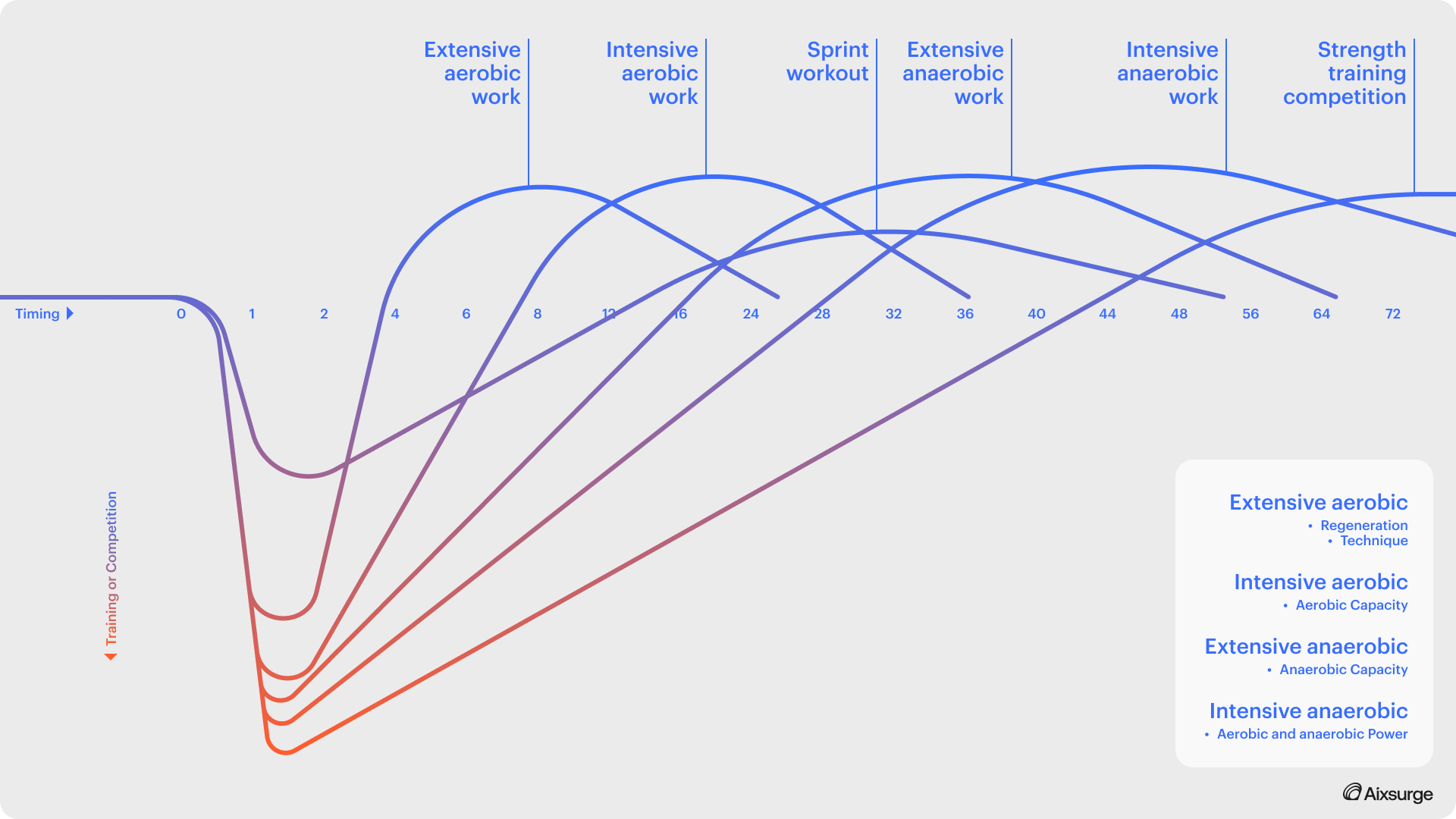
During a HIT training, muscle energy (glycogen) can run empty within 1-1.5h. Replenishing this energy source can take 24-48 hours of recovery.
After an all-out sprint, creatine phosphate levels drop dramatically. Returning creatine phosphate levels to normal takes roughly a couple of minutes.
In other words, the recovery time is determined by the duration required for the affected biological systems to fully recover.
Most triathletes will experience that long aerobic sessions require less recovery time (e.g. 8-36h) than high intensity workouts like VO2max intervals (e.g. 48-60h). That is because low intensity training causes little structural “damage”, and therefore only requires energy replenishment. Intense training requires longer recovery, since proteins and enzymes need to be reconstructed too.
Fitness, recovery quality and recovery time
The effect of an athlete’s fitness level and recovery quality on the recovery duration are often overlooked. Therefore we will discuss these in the Pitfalls and Challenges section. But first, we dive into how the supercompensation model tells you how to create your most effective training plan.
Using supercompensation in your training plan
Integrating the principles of supercompensation into a structured training program requires precise planning across different timescales: microcycles (days), mesocycles (weeks), and macrocycles (months or years). Each cycle has a specific purpose in leveraging supercompensation for peak performance.
Microcycle. In a microcycle the supercompensation theory teaches us to prioritise important workouts when fully recovered. This allows us to take full advantage of these key training sessions. It also shows the importance of alternating intense workouts with easy, active recovery days.
Mesocycle. When we zoom out a little bit, it becomes clear that it’s perfectly fine — and even beneficial — to have weeks in which we push ourself slightly beyond our current capabilities. As long as these “overreaching” weeks are followed by sufficient recovery weeks. 2-3 weeks of intense training followed by 1 week of active recovery is a common example.
Macro. On a macro level, the supercompensation theory allows us to focus on specific training adaptations in a specific time of the year. For instance: first dedicate a couple of months to endurance training, then switch to high-intensity work to boost VO2max and VLamax, then enter a short taper in which you recover and peak towards your event.
Pitfalls and challenges
Three common pitfalls when implementing the supercompensation theory are:
Misjudging training load, by ignoring the athlete profile
Misjudging recovery, by neglecting external factors
Failing to monitor progress
Let’s look a little closer and learn how to tackle them.
1. Misjudging training load
If you want to implement the supercompensation model, you need to accurately predict training load. There are many variables of an athlete’s (metabolic) profile that should be taken into account when doing so. To name a few:
VO2max: aerobic engine
VLamax: anaerobic engine
Anaerobic threshold, also known as lactate threshold,
Body composition: muscle mass, body weight, etc.
General: age, sex, health, etc.
If you do not take these into account, you easily end up misjudging training load.
For example: a certain high-intensity workout might be easy for an athlete with a high VLamax, while it can be very demanding for an endurance athlete with a low VLamax. This holds true, even if you base the interval intensity at an individual’s (functional) threshold power.
A highly tailored training session is also the foundation of knowing how long to recover.
2. Misjudging recovery
We’ve learnt that recovery is key. But recovery goes beyond “not training”. You should take this into account when predicting the speed at which you recover. Many factors like sleep, nutrition, stress and lifestyle play a role in the quality of recovery.
It goes without saying that a stressful day at work, combined with Friday afternoon drinks, is not comparable to a true rest day.
3. Failing to monitor progress
Even the best training program can’t guarantee completely predictable outcomes. That’s not how the body works. That’s why doing a performance test regularly is necessary to monitor whether you’re successfully implementing the supercompensation theory.
While many triathletes are used to testing, the key lies in understanding how to effectively interpret and apply the results. A performance test is useless if you don’t put the results into action.
Here are 3 important ingredients when monitoring your progress:
Know what your goal is
Perform tests to understand if you’re adapting into the right direction
Adjust the training program, based on the test results
Detraining and overtraining
If you misjudge training load or recovery, and fail to monitor progress, you’re unable to take advantage of supercompensation. This leads to ineffective training, demotivation or possibly detraining.
It could also lead to unnecessary fatigue, injury or even overtraining syndrome, which may take months or even years to recover from.
How Aixsurge helps applying the supercompensation method
Aixsurge integrates the principles of supercompensation into its dynamic training app, ensuring athletes can optimize their performance with structured, adaptive planning.
Aixsurge begins by aligning your training with key competition goals through carefully structured macro cycles. Each macro cycle incorporates periods of progressive overload, recovery, and tapering, all designed to maximize the supercompensation effect.
It bridges the gap between long-term goals and daily execution by breaking down macro cycles into detailed weekly microplans. These plans adapt to your progress, current fitness level, and life circumstances, ensuring the right balance of stress and recovery.
Download the Aixsurge app and make the most of the supercompensation method.
References
The concept of supercompensation was discovered in the mid-20th century, by physiologist Nikolai Yakovlev.
Viru A. Early contributions of Russian stress and exercise physiologists.J Appl Physiol (1985) 92: 1378–1382, 2002. https://journals.physiology.org/doi/full/10.1152/japplphysiol.00435.2001
As little as 1 week of training cessation can already negatively affect muscle energy stores by 20%. VO2max is significantly decreased in less than 4 weeks of insufficient training.
Mujika I, Padilla S. Detraining: loss of training-induced physiological and performance adaptations. Part I: short term insufficient training stimulus. Sports Med. 2000 Aug;30(2):79-87. https://pubmed.ncbi.nlm.nih.gov/10966148/
It could also lead to unnecessary fatigue, injury or even overtraining syndrome, which may take months or even years to recover from.
Meeusen R, Duclos M, Foster C, Fry A, Gleeson M, Nieman D, Raglin J, Rietjens G, Steinacker J, Urhausen A; European College of Sport Science; American College of Sports Medicine. Prevention, diagnosis, and treatment of the overtraining syndrome: joint consensus statement of the European College of Sport Science and the American College of Sports Medicine. Med Sci Sports Exerc. 2013 Jan;45(1):186-205. https://pubmed.ncbi.nlm.nih.gov/23247672/
Loek Vossen
Human Movement Scientist | CEO Molab, Sport Science and Technology Company
What is supercompensation, and how can it be applied in triathlon