
How to Calculate your Lactate Threshold Heart Rate (LTHR) — using threshold tests or training data
If you’re a triathlete, you should know your lactate threshold heart rate (LTHR). It’s the key to unlocking personalized training zones and pacing strategies that align with your current fitness level. To determine your LTHR, you don’t need an expensive lab. You can calculate your LTHR based on training data, or a simple LTHR test. Let’s get started!
What is your Lactate Threshold Heart Rate?
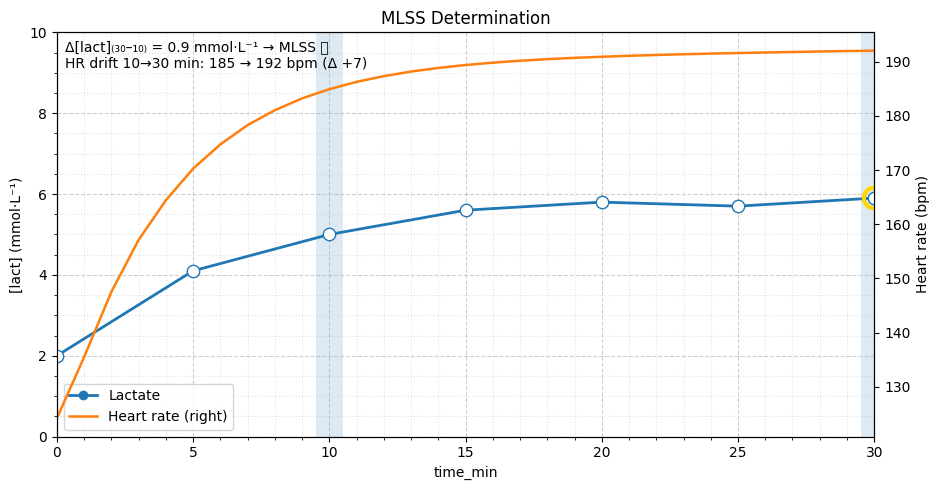
Your lactate threshold heart rate (LTHR) is the heart rate that corresponds to the highest exercise intensity at which your blood lactate concentration does not increase. You can also calculate your lactate threshold pace or power, instead of heart rate (this article).
It is relevant for triathletes, because threshold intensity is considered the highest effort that you can sustain for relatively long durations (e.g. 60 minutes).
While staying below threshold allows you to keep a steady effort for a long time, going above threshold will result in fatigue quickly.
Knowing your LTHR helps you to:
- Set precise heart rate training zones
- Pace correctly in races and key workouts
- Track progress over time
How to Calculate your Lactate Threshold Heart Rate
You don’t need lab equipment to determine your LTHR. There are several field tests you can do with just a heart rate monitor and a structured effort. In fact, your training or racing data might already include all the information you need to calculate threshold heart rate.
Here are the best threshold heart rate tests and calculations for triathletes:
- Critical Heart Rate (CHR) from training data or test
- Threshold heart rate from ramp test
- Threshold heart rate from a single effort (e.g. 20-30 min effort or 5k run)
After completing these efforts you can calculate your LTHR or use a LTHR calculator. Aixsurge is a triathlon app that walks you through the test protocol and works as a LTHR calculator immediately after finishing the test. It not only determines your threshold heart rate, it also calculates heart rate zones based on your power and pace thresholds. But this is only the start: you can add your triathlon goal to the app and it will create a personalized training program for you.
Download the app straightaway, or learn more about the LTHR tests via this article.
[BUTTON: download the app]
Calculate your threshold heart rate — using the Critical Heart Rate (CHR) formula
You may have heard about critical swim speed, critical power (cycling) or critical run velocity. It’s a way to calculate the speed/pace/power you can sustain. We can use a similar formula to calculate the corresponding Critical Heart Rate (CHR).
Let’s have a look at the protocol. Note that you can also get the data from your training and racing history.
Critical Heart Rate protocol
Perform a warm up. For example: 10 minutes easy + some sub-maximal accelerations.
In running and cycling:
- 3-5 minutes as fast as you can (max effort at steady pace)
- At least 15 minutes of recovery or next day
- 12-20 minutes as fast as you can (max effort at steady pace)
Cool down. For example: 10 minutes easy
Note that if you performed the cycling FTP test with a 5 min and a 20 min max effort, you can use those efforts to calculate critical heart rate.
Critical Heart Rate calculation
Here’s the formula* to calculate your threshold heart rate based on the CHR test:
CHR = (HBlim long effort — HBlim short effort) / (duration long effort — duration short effort)
With:
- HBlim long = average heart rate long effort * duration long effort (min)
- HBlim short = average heart rate short effort * duration short effort (min)
*This is a slightly simplified formula for the formula used in scientific research.
Instead of performing the protocol and calculation on your own, you can also use the Aixsurge app as a LTHR calculator. The app walks you through the test protocol and automatically calculates your threshold heart rate, using the scientifically validated formula. It adds heart rate to your training zones and writes a tailored training program for you, to make sure you reach your triathlon goals.
[BUTTON: download the app]
The science behind this threshold heart rate calculation
Science shows that this heart rate formula is a valid way to estimate your threshold heart rate — a reliable marker for setting training zones and predicting endurance performance, without needing lab equipment or gas analysis. It does so for cycling and running.
Find your lactate threshold heart rate — based on a RAMP test
RAMP tests are very common in cycling and running. You start at an easy pace and increase the intensity step-by-step until you can’t go any further.
For convenience, it’s best to perform a ramp test using an app like Aixsurge. The app walks you through the protocol and calculates your threshold heart rate.
Ramp protocol
Perform a warm up. For example: 10 minutes easy + some sub-maximal accelerations.
- Cycling: start at 100 watt. Increase power by 20 watt each minute. Stay seated, keep a steady cadence, and keep ramping up until you simply cannot continue.
- Running: start at 8 km/h. Increase velocity 1 km/h every 3 minutes. Keep ramping up until you simply cannot continue.
Cool down. For example: 10 minutes easy
Cyclists can easily perform the test on an indoor trainer, using ERG mode. Simply connect the trainer to an app like Aixsurge, which will automatically ramp up the intensity and calculate threshold heart rate.
Runners can perform the test on a treadmill (incline: 1%) or on the track.
Threshold calculation
After completing the ramp test, threshold power (cycling) or pace (running) should be determined first. Here’s how to calculate anaerobic threshold based on the ramp test — or other threshold tests.
Next, threshold heart rate can be determined by looking at the heart rate corresponding to the threshold power/pace. Take the average heart rate of the step at or above threshold intensity. For example: if threshold power equals 252 watt, take the average heart rate at step 260 watt.
When using the Aixsurge app, you’ll automatically get your threshold heart rate after completing the test. Additionally, training zones are determined and a training program is created, tailored to your triathlon goals. Learn more about Aixsurge.
Estimate threshold heart rate from a single max effort
In swimming and running, 30 minute tests are common lactate threshold heart rate (LTHR) tests. The same is true for a 20 minute test in cycling and a 5k test or race in running.
While the Critical Heart Rate method — which uses two efforts — is the preferred and more accurate approach, it’s also possible to estimate your lactate threshold heart rate using just a single effort. Just make sure the effort is a max effort at a steady pace.
Recommendations:
Estimate threshold heart rate based on 20 min FTP test (cycling)
If you did an FTP test using the original functional threshold protocol, you did both a 5 minute and a 20 minute max effort. In that case, use the Critical Heart Rate method.
If you only did a 20 min max effort, estimate the threshold heart rate by looking at the average heart rate from the final 5 minutes of the 20 minute effort.
Estimate LTHR based on 30 min test (swimming, cycling, running)
You can use a recent 30 min max effort from training or racing to estimate your threshold heart rate in all three sports. Just make sure it was a max effort at a steady pace.
Simply take the average heart rate from the final 20 minutes. For instance by lapping after the initial 10 minutes.
Estimate LTHR based on a 5k run
In the book Triathlon: Training Basics, Gale Bernhardt shares her way of estimating the lactate threshold heart rate (LTHR) based on the data from a 5k run. The formula:
Running LTHR = Average heart rate during 5k / 1.04
How to calculate heart rate zones based on threshold heart rate
You can use your lactate threshold heart rate to calculate heart rate zones. For instance:
Training zones for runners, based on lactate threshold heart rate:
|
Zone 1 |
Recovery |
< 85% of LTHR |
|
Zone 2 |
Endurance |
85% — 89% LTHR |
|
Zone 3 |
Tempo |
90% — 94% LTHR |
|
Zone 4 |
Threshold |
95% — 102% LTHR |
|
Zone 5 |
Anaerobic / VO2max |
> 103% LTHR |
Training zones for cyclists, based on lactate threshold heart rate:
|
Zone 1 |
Recovery |
< 68% of LTHR |
|
Zone 2 |
Endurance |
69% — 83% LTHR |
|
Zone 3 |
Tempo |
84% — 94% LTHR |
|
Zone 4 |
Threshold |
95% — 105% LTHR |
|
Zone 5 |
Anaerobic / VO2max |
> 106% LTHR |
Alternatively, you can use the Aixsurge triathlon app that creates swim, bike and run training zones based on pace/power and gives you the corresponding heart rates. For example:
“Ride at 170–180 watts. Your heart rate should stay between 135–140 bpm.”
LTHR calculator
If you need a 360 degree solution to test and calculate your threshold heart rate to create training zones, use the Aixsurge. It’s far more than just an LTHR calculator. It creates a personalized training program using micro, macro and meso training cycles. All based on the scientific supercompensation theory.
References
The Critical Heart Rate formula is a valid way to estimate your threshold heart rate in cycling.
- Mielke, Michelle & Housh, Terry & Hendrix, C & Zuniga, Jorge & Camic, Clayton & Schmidt, Richard & Johnson, Glen. (2010). A Test for Determining Critical Heart Rate Using the Critical Power Model. Journal of strength and conditioning research / National Strength & Conditioning Association. 25. 504-10. 10.1519/JSC.0b013e3181b62c43.
https://pubmed.ncbi.nlm.nih.gov/20179651/
The Critical Heart Rate formula is also valid in running.
- Bergstrom HC, Housh TJ, Cochrane KC, Jenkins ND, Buckner SL, Goldsmith JA, Zuniga JM, Schmidt RJ, Johnson GO, Cramer JT. Application of the Critical Heart Model to Treadmill Running. J Strength Cond Res. 2015 Aug;29(8):2237-48. doi: 10.1519/JSC.0000000000000869. PMID: 25647653.
https://pubmed.ncbi.nlm.nih.gov/25647653/

Table of Contents
- What is your Lactate Threshold Heart Rate?
- How to Calculate your Lactate Threshold Heart Rate
- Calculate your threshold heart rate — using the Critical Heart Rate (CHR) formula
- Find your lactate threshold heart rate — based on a RAMP test
- Estimate threshold heart rate from a single max effort
- How to calculate heart rate zones based on threshold heart rate
- LTHR calculator
- References