Takeaway
Each key triathlon event needs a separate macrocycle

If you want to be at your best on the day of your triathlon event, you need a structured training plan. Training periodisation breaks down your path to peak performance into training cycles that all have a specific focus.
These macro, meso and microcycles apply the supercompensation theory and ensure that every workout contributes to your bigger goal.
When done correctly, training periodisation makes overtraining and underperforming a thing of the past.
This article guides you through the theory and application of training periodisation and training cycles, helping you to reach peak performance on race day.
Training periodisation is the breakdown of a training year into training cycles that build upon each other, to reach peak form at the right moment.
Training periodisation starts with knowing when you want to reach peak form. E.g. during key events like triathlon races. Once you determined when you want to reach peak form, you need to acknowledge that:
Training cycles are your roadmap to take this theory into practice.
A training cycle is a structured phase within your overall training plan. It breaks down your triathlon season into manageable segments.
Training cycles help to structure your training plan. For example when your next triathlon event is still months ahead. Or when you plan to do more than one triathlon in a season.
Since there is no single workout that improves all physical aspects like VO2max, VLamax, Anaerobic Threshold, cycling position, running economy, swimming technique etc, training cycles allow you to focus on a specific physiological adaptation.
Last but not least: training cycles help to stay motivated by creating subgoals towards your triathlon event.
When implementing training cycles, you should separate three cycles:
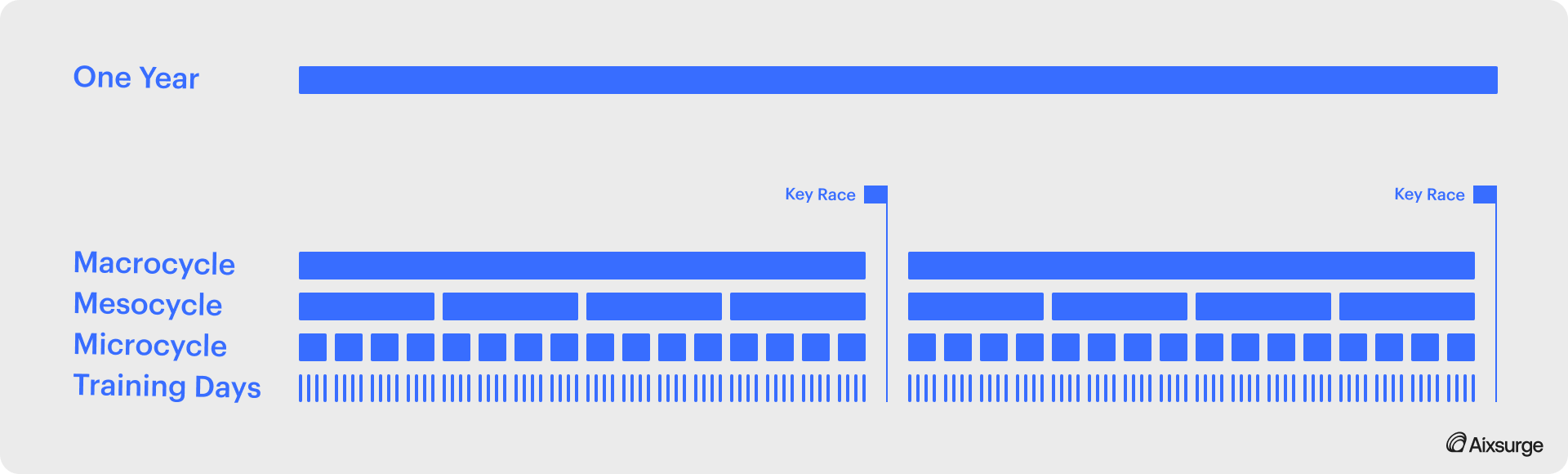 Fig 1. 1-year training program with 2 key races and several macro-, meso- and microcycles.
The macrocycle is the longest of the three training cycles. In a training plan, a macrocycle is usually a couple of months long, and serves as a helicopter view.
Typically, each key triathlon event needs a macrocycle. For instance: if you plan to do 3 important triathlon races, your season contains 3 macrocycles.
Each key triathlon event needs a separate macrocycle
In practice some important races may take place with very little (e.g. 2 weeks) time in between. In that case, it’s common to only create one macrocycle that contains both triathlons.
Additionally, since there is so much to learn from analyzing a completed macrocycle, it’s best to focus on the first one before planning a second or third in detail.
In his book The Science of Winning, renowned coach and PhD Jan Olbrechts says each macrocycle should contain 3 phases:
To highlight the importance of planning these phases, a scientific case study of an Olympic champion revealed that after an 8-week post-Olympic break, it took over 20 weeks of retraining to approach Olympic-level fitness.
To improve training planning, each of the three phases (base, competition, transition) contain several mesocycles.
A mesocycle is a training cycle within the macrocycle, designed to improve a specific aspect of your physiology. In a training plan, a mesocycle is typically 3 to 6 weeks long. It always consists of two components:
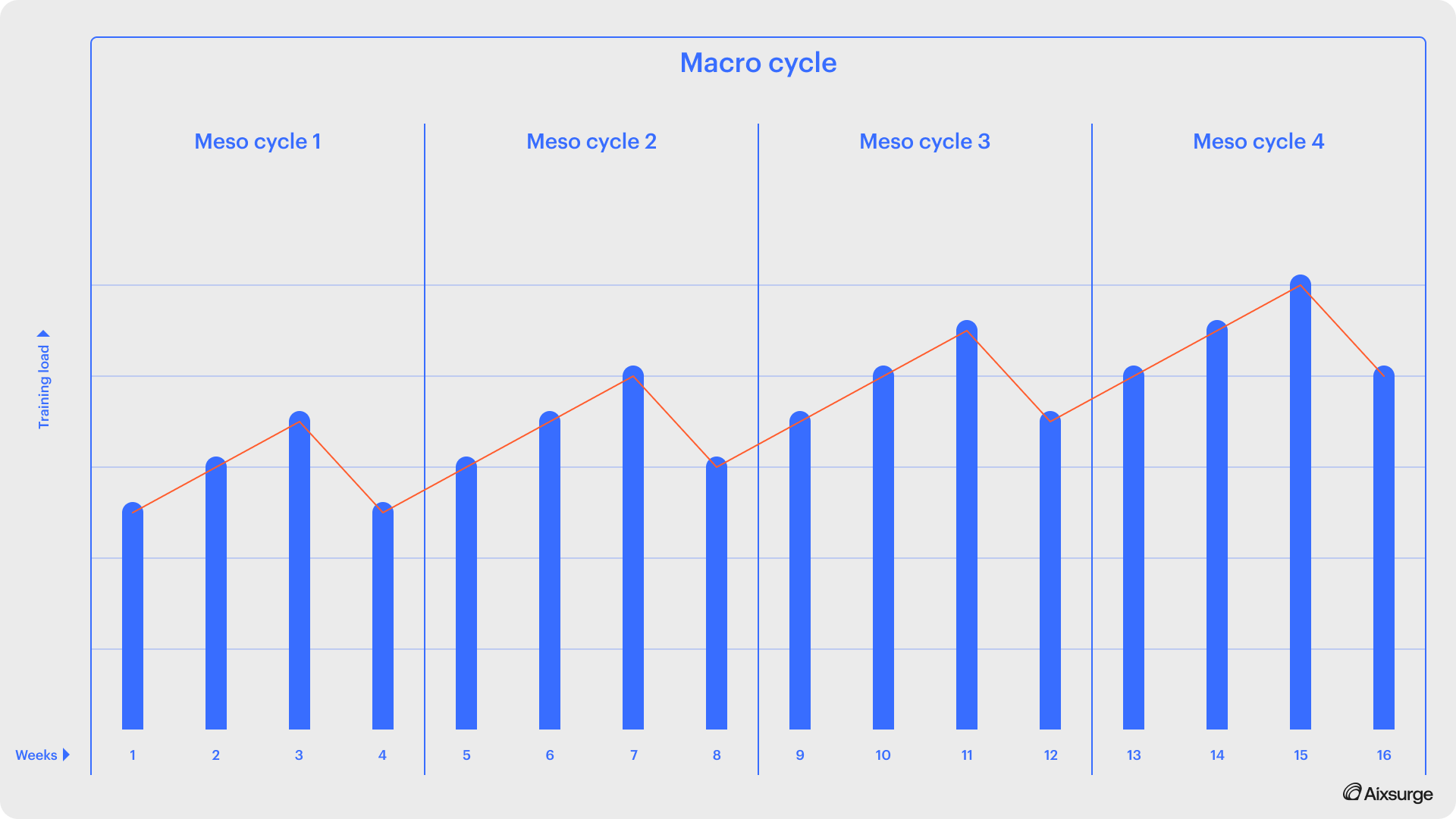 Fig 2. Each meso cycle contains a progressive overload and a recovery phase
As mentioned earlier, there is no single workout that improves all physical aspects at the same time. Mesocycles allow you to focus on specific aspects like endurance, strength or speed.
If you want to be sure your mesocycles are effective, you need to do some sort of performance test before and after each mesocycle. This helps to measure whether you’ve accomplished the physiological adaptation you’ve had in mind.
More about the importance of performance tests to measure the effectiveness of your training cycles in a bit.
Let’s first look at a 4-week mesocycle as an example. If this is your first mesocycle in a macrocycle, you could dedicate it to low intensity endurance training. After all, you’re still in the base training phase.
In this example, the goal is to increase aerobic capacity with long steady workouts in swimming, cycling and running.
The first 3 weeks could contain easy workouts with increasing duration. In week 4, the training frequency and duration are decreased to enhance recovery and boost supercompensation. In the previous image you see how this first mesocycle would look like.
While a macrocycle is more of an overview, a mesocycle describes the goal of a certain training block in detail. A microcycle takes it one step further.
A microcycle is the shortest training cycle, which provides a detailed week plan. Although a microcycle is usually 7 days long, it is totally fine to use slightly shorter or longer microcycles, e.g. in a 5-day training camp.
The objective of a microcycle is to prioritise the most important workouts in a week plan.
In a microcycle, you prioritise the most important workouts in a week
Although science shows that untrained athletes improve fitness regardless of whether they are “weekend warriors” (train twice during the weekend) or train with a smoother distribution, this is likely not the case for seasoned triathletes. They should plan and prioritise key workouts to maximise training benefit.
In The Science of Winning, Jan Olbrechts shares 3 tips to do so:
So far we talked about training cycles. Even the shortest cycle — the microcycle — can be split up into more detailed units: the training units.
Each training unit must be put into the context of the macro, meso and microcycle. It usually consists of a warm up, one or two main parts with recovery in between, and a cool down.
Simply open the Aixsurge to see what’s on your plate today. Workouts are automatically synced with your sportwatch.
We’ve learned that:
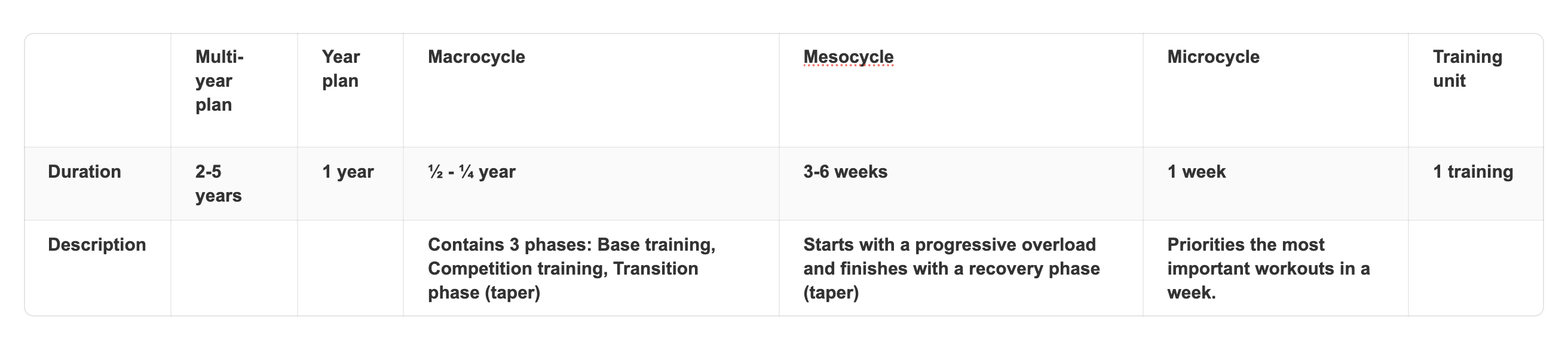 Fig 3. Summary of training cycles in a periodisation plan.
But how do you know whether your training cycles are actually leading to the desired outcome?
Performance tests are the answer. They allow you to test your current fitness, monitor your progress and adapt your training plan accordingly. As a result you decrease the risk of overtraining and underperforming.
The test results are used to periodise your future training plan, so you reach peak performance on the day of your triathlon event.
Ready to put theory into practice? Here are the 10 steps you can take yourself or automate with the Aixsurge.
Step 1: Analyze your historical training. What worked and what did not? Use this as a lesson.
Step 2: Perform an exercise test to learn what your current fitness profile looks like.
Step 3: Set clear goals for the season. This could be anything from finishing your first triathlon to qualifying for IRONMAN Kona Hawaii.
Step 4: Select your key events. Most triathletes pick 2 races. Only experienced triathletes can select up to 4 races.
Step 5: Define macrocycles. Each key event needs a separate macrocycle, unless they take place with very little (e.g. 2 weeks) time in between. You can then combine them in one macrocycle.
Step 6: Schedule training camps, secondary races and external factors like holidays, busy workweeks or exams etc.
Step 7: Divide macrocycles into mesocycles of 3 to 6 weeks. Set a specific goal for each mesocycles: what physiological adaptation do you target?
Step 8: Divide mesocycles into microcycles. Prioritise key workouts that boost your desired physiological adaptation.
Step 9: Create specific training units (workouts) with a warmup, main sets and a cool down.
Step 10: Schedule performance tests to track progress and allow training cycle adaptations based on objective data.
Training periodisation with training cycles
Case study: base, competition, transition phases after the Olympic Games
While untrained athletes improve fitness regardless of whether they are “weekend warriors” or train with a smoother distribution, this is likely not the case for seasoned triathletes.

Table of Contents