
VO2max intervals: short vs long (for triathletes)
Spending time near maximal oxygen uptake improves VO2max. But what strategy is more effective: many short high-intensity intervals, or a few 5-minute intervals? Here’s the answer, tailored to triathletes.
What are VO2max intervals?
VO2max intervals are intervals performed at or near maximal oxygen uptake, with the goal of improving VO2max and building an aerobic base.
During exercise, near-maximal oxygen uptake feels like being “out of breath”, breathing as fast and deep as possible.
You’ve probably experienced that all kinds of interval durations and intensities can lead to this feeling.
This should make clear that there’s no single VO2max interval length or intensity. You can reach maximal oxygen uptake after a set of short high intensity sprints with limited recovery. Or after a 3 minute all out effort. Or after a 20+ minute lactate threshold test. And so on.
“There’s no single VO2max interval length or intensity”
In fact: basically any exercise intensity above threshold will result in maximal oxygen uptake (VO2max) if the interval duration is long enough. At a very high intensity, triathletes can reach VO2max in 2-3 minutes. At intensities only slightly above threshold, it will take much longer. For instance: more than 10 minutes.
“Any exercise intensity above threshold will result in maximal oxygen uptake (VO2max) if the interval duration is long enough.”
That is because oxygen uptake (aka VO2 kinetics) depends on the exercise intensity and duration:
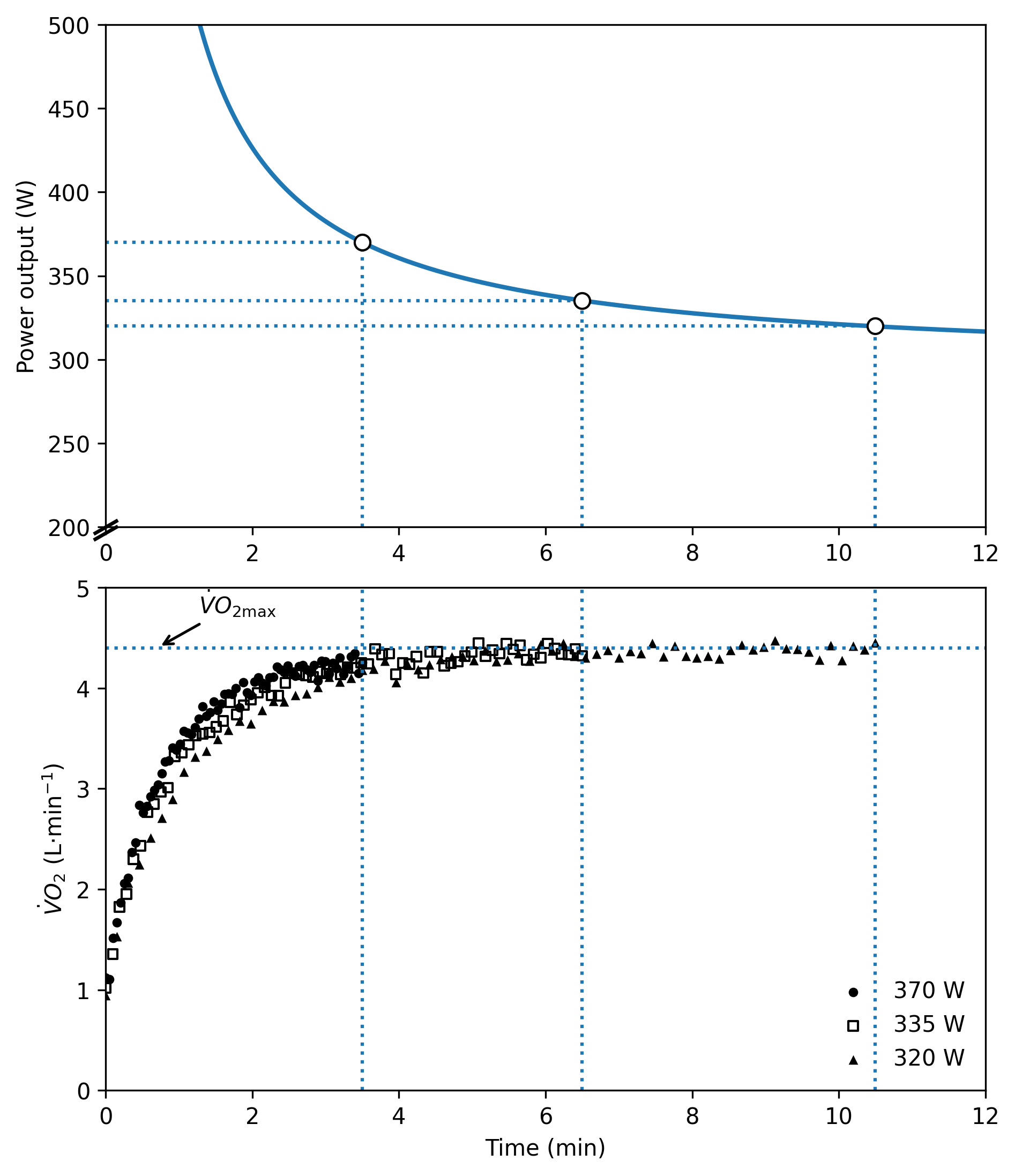 For intensities above threshold: the higher the intensity, the sooner VO2max is reached.
So if there’s no single VO2max interval duration or intensity, which duration and intensity should you use to boost VO2max?
Typical VO2max interval duration for triathletes
Typical VO2max intervals are 5 minutes long. Most triathletes need about 3 min to reach maximal oxygen uptake. Therefore, 5 min intervals allow to reach VO2max at a slightly lower exercise intensity.
VO2max intervals are commonly performed in training zone 5, which is also known as the VO2max training zone. This zone starts at 105% of threshold speed (swimming and running) or threshold power (cycling). Or at about 105% of lactate threshold heart rate.
Since this intensity is above threshold, it will lead to maximal oxygen uptake if the interval duration is long enough.
But just because this is commonly meant with “VO2max intervals” does not mean they are most effective. Let’s see what science says about the best VO2max interval length.
Short vs long VO2max intervals: the science
On a high level, scientists suggest that training at or near maximal oxygen uptake is the most effective training intensity to increase VO2max. Consequently, several studies have investigated which training protocols allow athletes to accumulate the greatest amount of time at or near VO2max.
Are short or long intervals more effective for time spent at VO2max?
This study clearly shows that you spend much more time near VO2max when doing repeated short intervals to exhaustion (roughly 20×30 s) than during a single continuous effort to exhaustion (roughly 8 minutes). Even though the total interval time did not differ much from the single effort time.
So yes, to increase time near VO2max, do repeated intervals. But should those be long or short?
Let’s answer this question by looking at 3 interesting studies.
A study in 2003 looked at 8 well trained triathletes, with an average VO2max of 71.1 ml/min/kg. The triathletes performed 3 running interval sessions, with 30, 60 or ~120 s intervals at 100% vVO2max (velocity associated with VO2max).
The total interval time was the same for all sessions.
What do you think? Which results in the most time spent near VO2max?
Longer VO2max interval durations resulted in greater time spent near VO2max. Both the 60 s and ~120 s protocols accumulated substantially more time near VO2max than the 30 s protocol. There was no significant difference between the two longer interval protocols.
This suggests you need to do longer VO2max intervals. However…
The triathletes perceived the short interval protocol as a much easier session (RPE) and their maximal oxygen uptake was much lower too. So maybe we should not compare 30 s intervals with 60 s intervals when they are performed at the same intensity.
Instead, it’s likely that shorter intervals require higher intensities than long ones, to elicit the same stimulus.
That’s exactly what the researchers of this study must have thought. They looked at 8 elite cyclists, with an average VO2max of 73.9 ml/min/kg. The cyclists performed two interval protocols: short intervals (30 s) vs long intervals (5 min). Both at the highest possible average power output.
Again, the total interval time was roughly the same. But this time, the 30 s interval intensity was significantly higher and the perceived exertion was similar between both protocols.
Which do you think resulted in the most time spent near VO2max?
The study shows opposite results: shorter VO2max intervals resulted in greater time spent near VO2max, although not significantly.
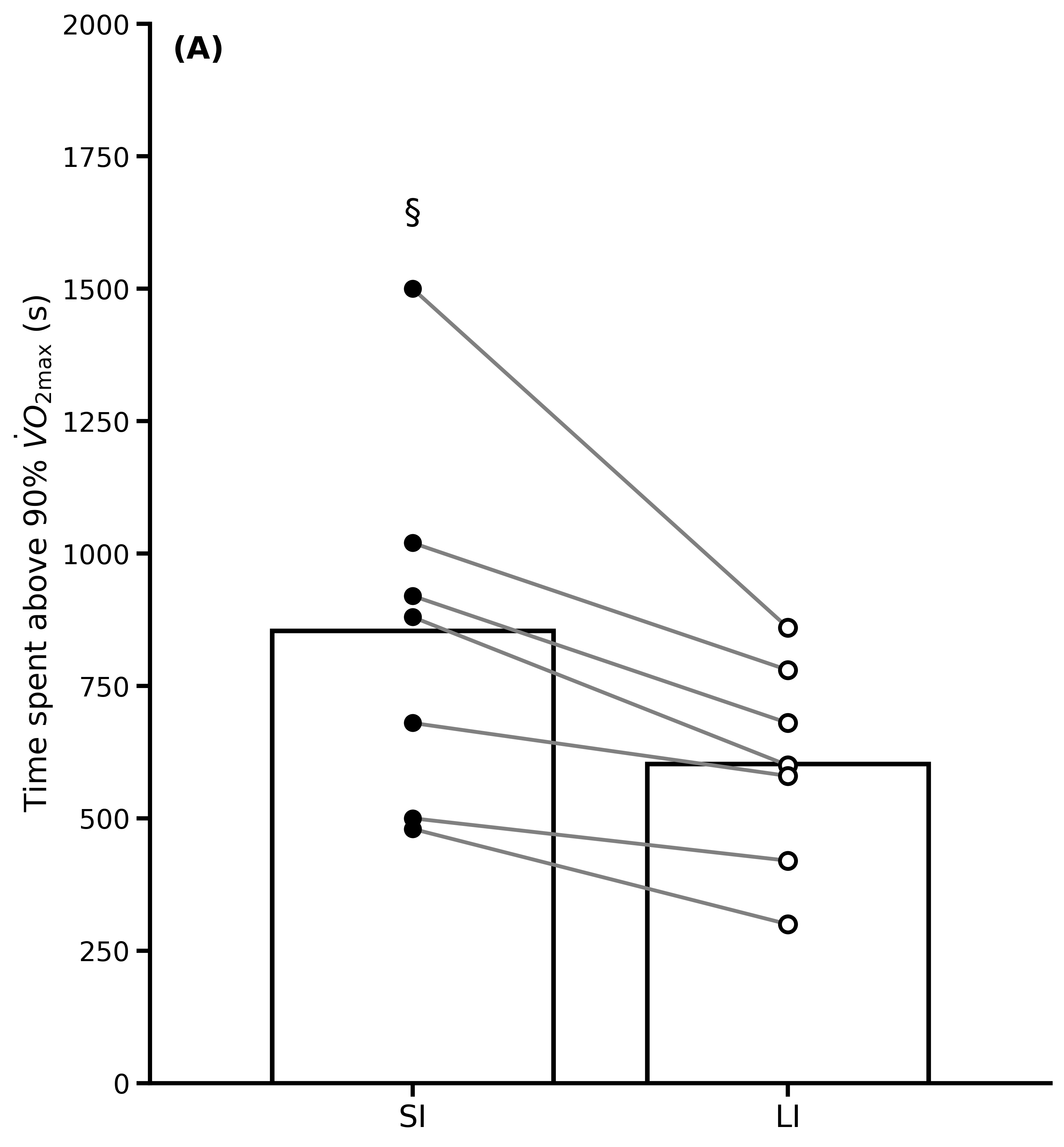 Although not significantly, shorter intervals result in greater time spent near VO2max.
This suggests you need to do shorter VO2max intervals. However…
Another study looked at 12 highly trained middle distance runners (male and female) and found that long intervals (3 min at 95% vVO2max) result in significantly more time spent near VO2max, compared to short intervals (30 s at 100% vVO2max). Again with time matched efforts and similar perceived efforts.
Conclusion: there is no clear evidence that either short or long intervals are superior for time spent near VO2max.
But maybe we should not search for the interval duration that results in most time spent near VO2max, and look at actual VO2max improvements instead:
Are short or long intervals more effective at increasing VO2max?
Ever heard of the Rønnestad 30/15s? These are 30 s intervals with 15 s recovery, that aim to boost your VO2max. They are named after the well known researcher Dr. Bent Rønnestad.
So how effective are those short intervals at increasing VO2max, compared to long intervals?
In 2014 Rønnestad’s own study compared 30 s intervals with 5 min intervals. He showed that short intervals result in a larger improvement in VO2max (+8.7%) than long intervals (+2.6%).
However, in a similar study in 2020, Rønnestad concluded that: “there was no group difference in change of VO2max” between the short and long interval groups.
A different study with 14 triathletes (average VO2max of 58.7 ml/min/kg) also compared long 5 min intervals with short intervals (10, 20 and 40 s).
Who increased their VO2max most?
Long interval and short interval training interventions led to the same increase in VO2max: ~7%.
This is (again) confirmed by a systematic and meta-analysis, including six studies:
“There was no difference in change in VO2max between [short interval vs long interval] groups.”
Conclusion: there is no clear evidence that either short or long intervals are superior for improving VO2max.
That said, long intervals do fundamentally differ from short intervals. Which means one can still be better than the other for you, being a triathlete. Here’s why and how to find out what’s best for you.
How to decide which VO2max interval length is best for you
Short and long intervals seem to result in similar aerobic (VO2max) improvements. Therefore, it makes sense to base your decision on the anaerobic (VLamax) energy system instead.
Short intervals at higher intensities require more anaerobic energy supply. As a result, your anaerobic energy system will improve and become more dominant.
This was already shown in the 1996 Tabata study, where both endurance training (ET) and short interval training (IT) increased VO2max, but only IT increased anaerobic capacity.
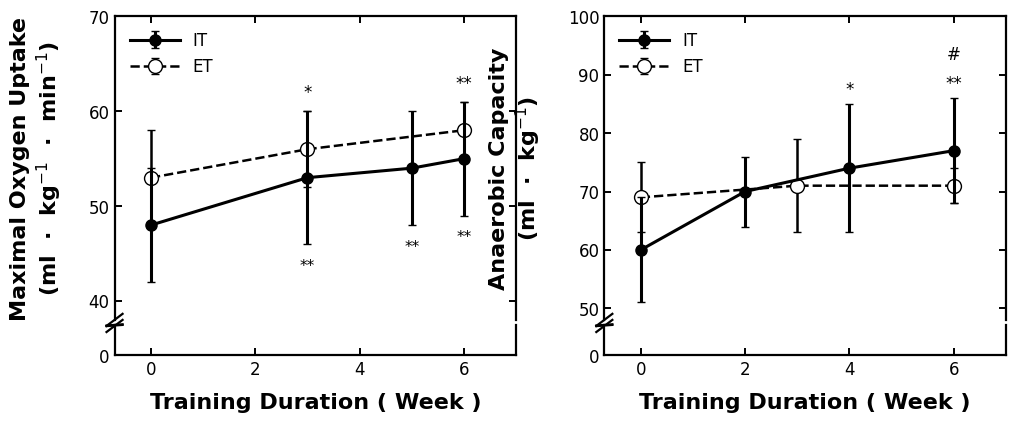 Left: both endurance training (ET) and short interval training (IT) increase VO2max. Right: only IT increases anaerobic capacity
More recent studies like the ones discussed earlier confirm that shorter intervals improve typical anaerobic performances like a 30 s all-out to a greater extent than longer intervals.
Although that sounds beneficial, many triathletes actually benefit from a less dominant anaerobic energy system (lower VLamax). That is because although the anaerobic engine provides energy quickly, it relies on carbohydrates, a precious fuel that can easily become limiting during long distance triathlons.
So triathletes with a high VLamax (often beginners and trained amateurs) are more likely to benefit from long VO2max intervals, while those that already have a very low VLamax (often experienced professionals) are likely to benefit more from short VO2max intervals.
Not sure whether your VLamax is high or low? Doubting whether you should pick long or short VO2max intervals? Aixsurge helps to create an athlete profile and decides based on that profile which VO2max intervals work best for you. Not only that, it also schedules those intervals when they are most effective. Start now.
Literature
Training at or near VO2max is the most effective training intensity to increase VO2max.
- Midgley, A W, and L R Mc Naughton. “Time at or near VO2max during continuous and intermittent running. A review with special reference to considerations for the optimisation of training protocols to elicit the longest time at or near VO2max.” The Journal of sports medicine and physical fitness vol. 46,1 (2006): 1-14.
https://pubmed.ncbi.nlm.nih.gov/16596093/
You spend much more time near VO2max when doing repeated short intervals than during a single continuous effort.
- Billat, V L et al. “Intermittent runs at the velocity associated with maximal oxygen uptake enables subjects to remain at maximal oxygen uptake for a longer time than intense but submaximal runs.” European journal of applied physiology vol. 81,3 (2000): 188-96. doi:10.1007/s004210050029
https://pubmed.ncbi.nlm.nih.gov/10638376/
Longer VO2max interval durations resulted in greater time spent near VO2max.
- Millet, Gregoire P et al. “VO2 responses to different intermittent runs at velocity associated with VO2max.” Canadian journal of applied physiology = Revue canadienne de physiologie appliquee vol. 28,3 (2003): 410-23. doi:10.1139/h03-030
https://pubmed.ncbi.nlm.nih.gov/12955868/
Shorter VO2max intervals resulted in greater time spent near VO2max.
- Almquist, Nicki W et al. “Systemic and muscular responses to effort-matched short intervals and long intervals in elite cyclists.” Scandinavian journal of medicine & science in sports vol. 30,7 (2020): 1140-1150. doi:10.1111/sms.13672
https://pubmed.ncbi.nlm.nih.gov/32267032/
Long intervals result in significantly higher time spent near VO2max.
- Fleckenstein, Daniel et al. “Faster intervals, faster recoveries — intensified short VO2max running intervals are inferior to traditional long intervals in terms of time spent above 90% VO2max.” Frontiers in sports and active living vol. 6 1507957. 6 Jan. 2025, doi:10.3389/fspor.2024.1507957
https://pubmed.ncbi.nlm.nih.gov/39835194/
Short intervals result in a larger improvement in VO2max.
- Rønnestad, B R et al. “Short intervals induce superior training adaptations compared with long intervals in cyclists — an effort-matched approach.” Scandinavian journal of medicine & science in sports vol. 25,2 (2015): 143-51. doi:10.1111/sms.12165
https://pubmed.ncbi.nlm.nih.gov/24382021/
There was no group difference in change of VO2max.
-
Rønnestad, Bent R et al. “Superior performance improvements in elite cyclists following short-interval vs effort-matched long-interval training.” Scandinavian journal of medicine & science in sports vol. 30,5 (2020): 849-857. doi:10.1111/sms.13627
Long interval and short interval training interventions led to the same increase in VO2max.
- Etxebarria, Naroa et al. “High-intensity cycle interval training improves cycling and running performance in triathletes.” European journal of sport science vol. 14,6 (2014): 521-9. doi:10.1080/17461391.2013.853841
https://pubmed.ncbi.nlm.nih.gov/24206175/
There was no difference in change in VO2max between groups.
- Rosenblat, Michael A et al. “Effect of High-Intensity Interval Training Versus Sprint Interval Training on Time-Trial Performance: A Systematic Review and Meta-analysis.” Sports medicine (Auckland, N.Z.) vol. 50,6 (2020): 1145-1161. doi:10.1007/s40279-020-01264-1
https://pubmed.ncbi.nlm.nih.gov/32034701/
Both endurance training (ET) and short interval training (IT) increased VO2max, but only IT increased anaerobic capacity.
- Tabata, I et al. “Effects of moderate-intensity endurance and high-intensity intermittent training on anaerobic capacity and VO2max.” Medicine and science in sports and exercise vol. 28,10 (1996): 1327-30. doi:10.1097/00005768-199610000-00018
https://pubmed.ncbi.nlm.nih.gov/8897392/

Jump straight to:
- What are VO2max intervals?
- Typical VO2max interval duration for triathletes
- Short vs long VO2max intervals: the science
- Are short or long intervals more effective for time spent at VO2max?
- Are short or long intervals more effective at increasing VO2max?
- How to decide which VO2max interval length is best for you
- Literature