How to train like a pro triathlete: volume and intensity per sport
So what does it take to become a professional triathlete? Do you really need to train 1.000+ hours per year? And if so, which sport deserves most of your time? And at what intensity? Let’s answer these questions for Olympic and full distance (IRONMAN) triathletes, male and female. BONUS: actionable tips on how to apply these insights to your own training plan.
How many hours a day do professional triathletes train?
Most of us have dreamed of being a pro athlete, if only for a moment. But what does it take?
Anecdotal evidence shows most professional full distance triathletes (8:30+ male, 9:30+ female) train at least 1.000 hours per year. That equals a little over 19 hours per week on average. The world class pro (sub-8 hours male, sub-9 hours female) would need to add another 200 to 500 hours per year on top of that.
If we assume one rest day per week, this means world class professional triathletes train 4-5 hours per day. That’s a lot! And it turns out, there’s no real shortcut.
Scientific literature indeed shows that — at least in running — doing more in training increases performance near-linearly.
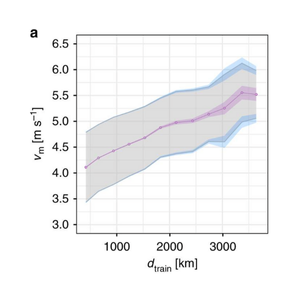
From: Emig & Peltonen, 2020
So how much time do pro triathletes train? Let’s answer this question, differentiating between full distance (IRONMAN) vs olympic distance, and male vs female.
Training volume: male long distance (IRONMAN) triathletes
Research examined the training volume of male elite long distance triathletes (n = 19), who represented their country at the World Championships.
During a typical heavy training week, taken just before the taper phase leading into a National Championship, they averaged 19.5 hours of training.
However, some male elite triathletes trained more than 27 hours during such a heavy training week.
These findings are in line with what professional triathlete Cody Beals shared:
“The three weeks that were the meat of this block averaged (…) out to a total training volume of about 22-24 hours per week. My training tends to be on the lower volume, higher intensity side compared to my peers.”
Anecdotal evidence shows a high volume week can be 35 hours, or even up to 40 hours in a training camp.
Learn more about planning high volume weeks in your micro, meso and macro training cycles.
During these high volume weeks, it’s important to distribute the time strategically between the three sports, to prevent injuries and overtraining. More about that in a bit. Spoiler: Aixsurge does exactly that for you, so you don’t need to worry about it.
Training volume: female long distance (IRONMAN) triathletes
If we look at the same scientific publication, female elite long distance triathletes (n = 7) trained a very similar 18.5 hours per week on average. Some trained more than 21 hours per week on average.
This is somewhat lower than the 23 hours mentioned by professional triathlete Kate Comber, a two-time IRONMAN podium finisher. However, her total includes 1.5 hours of strength training, which was not considered in the scientific publication.
Let’s compare those numbers to half distance (70.3) and Olympic distance triathletes.
Training volume: male half distance (70.3) and Olympic triathletes
Surely, a half distance or Olympic distance triathlon takes less time to finish. But does that mean those pro triathletes also train less?
As you might expect, male elite Olympic distance triathletes train a bit less than full distance triathletes.
According to the same research, male elite Olympic distance triathletes (n = 12) train 15.6 hours on average, during a typical heavy training week. These training hours were divided into 12 training sessions on average.
That’s roughly 4 hours and 2 workouts less than their full distance counterparts.
Big difference, right?
Well.
Some OD triathletes trained more than 19 hours during a heavy training week. Which equals the average of full distance triathletes.
On top of that, this study shows male elite Olympic distance triathletes are more likely to train 17.4 hours per week. This makes more sense, especially when we compare it to the training volume found in women.
Training volume: female half distance (70.3) and Olympic triathletes
We saw that women have roughly the same training volume when preparing for a full distance triathlon than men. Let’s see if that holds true for half distance and Olympic distance triathletes.
While some publications show that female elite Olympic distance triathletes train 13.4 hours per week, that is probably at the lower end of the spectrum. An interesting case study shows that professional triathlete Ainhoa Murúa trained approximately 21 hours per week on average. This was reported in the year prior to the London Olympics 2012, where she finished 7th.
That is quite a bit more than previously reported training volumes for both male and female. Which is confirmed by the paper:
“(…) mean weekly swim, bike, and run volumes were, respectively, (…) 80%, 43%, and 35% higher than those previously reported for elite male and female Olympic distance triathletes.”
Some high volume weeks even peaked towards 30 hours per week.
|
In summary: |
How you distribute this time over all three sports becomes increasingly important when total training volume goes up. Start using Aixsurge if you want a personal recommendation on how to do this, given your own training availability and fitness.
Let’s continue learning more about how pros distribute their time over swimming, cycling and running.
How many hours do pro triathletes spend on swimming, cycling and running?
Now that we have an idea of how much professional triathletes train, it’s interesting to see how they distribute this time over all three sports.
Looking at the literature used so far, time distribution becomes super clear. For both men and women participating in Olympic distance triathlons, time distribution is:
Swim 35%
Bike 40%
Run 25%
For an average 18-19 hour training week, this comes down to:
Swim: 6.5 hours
Bike: 7.5 hours
Run: 4.5 hours
When we compare this with elite IRONMAN triathletes, something interesting pops up. Even though full distance triathletes usually train more overall, their running volume is about the same as that of Olympic distance triathletes. That probably has something to do with the fact that running more, increases the risk of injury significantly.
As a result, running makes up a smaller share of training for elite full distance triathletes. Literature shows their higher training volume comes mainly from cycling.
Full distance (IRONMAN) triathlete’s time distribution:
Swim 32%
Bike 47%
Run 21%
For a typical 20 hour training week, this roughly comes down to:
Swim 6.5 hours
Bike 9.5 hours
Run 4.5 hours
If we look at the example training programs shared by pro IRONMAN triathletes Cody Beals and Kate Comber again, it becomes clear that for them, time spent on swimming and running is very similar, while cycling takes up a larger portion than reported in research:
Cody Beals:
Swim 25%
Bike 52%
Run 23%
Kate Comber:
Swim 21%
Bike 58%
Run 21%
This is more in line with anecdotal evidence, saying time spent in swimming and running is roughly equal, while time spent in cycling is >50%.
|
In summary: |
Outliers aside, the maximum duration of a long workout is typically not above:
Longest swim: 4500m
Longest bike: 6 hours
Longest run: 20 — 30 km
That holds true for both men and women, OD and LD.
How often do professional triathletes train?
According to literature, long distance (IRONMAN) triathletes train a little over 14 times per week. This is a bit more than Olympic distance (OD) triathletes, who train 12 times during a typical training week.
However, if we combine it with anecdotal evidence, there’s no reason to assume there’s any difference between OD or LD and male or female triathletes. They all do about 12 — 16 sessions per week:
Swim 4-6x per week
Bike 3-5x per week
Run 4-6x per week
Most add 1-3 strength sessions on top of that.
If you want a triathlon training program that fits YOUR needs, try Aixsurge.
Training volume and frequency are only one side of the coin. To understand the full picture, you also need to know the training intensity.
At what intensity do professional triathletes train?
To become a pro triathlete takes a certain amount of training volume. There’s no real short cut. But what about training intensity?
The training intensity distribution is probably what makes a training program unique.
What intensity distribution works best for you, depends on your current profile and the goal you’re chasing after.
For instance, while some may benefit most from Pyramidal training (e.g. 70% in zone 1, 20% in zone 2, 10% in zone 3), others are probably better of with a more Polarized approach (e.g. 80% in zone 1, 20% in zone 3).
For now, let’s just observe what the pros do.
If we look at the example of Ainhoa Murúa (Olympic distance), we see the following intensity distribution:
|
Zone 1 (easy) |
Zone 2 (moderate) |
Zone 3 (hard) |
|
|
Swim |
74% |
16% |
10% |
|
Bike |
88% |
10% |
2% |
|
Run |
85% |
8% |
7% |
|
Total |
~82% |
~12% |
~6% |
Overall, most time is spent in zone 1 (~82%), less in zone 2 (~12%) and least in zone 3 (~6%). The examples of Cody Beals (IRONMAN) and Kate Comber (IRONMAN) show a similar pattern: aerobic base training is clearly their main focus.
It looks like cycling is mainly used to create volume in zone 1, while swimming (and running) allow for higher intensities too.
How to apply this to your (half) IRONMAN training plan
So how can we learn from these findings, and apply them to our own (IRONMAN) training program?
We’ve learned that — as long as you respect the supercompensation principle and recover well — more training hours typically lead to better performance. That is probably true for Olympic distance, half distance and full distance (IRONMAN) triathletes.
If you want to copy what the professionals do, spend about 40 — 50% of your training time on the bike. Split the remaining time between swimming and running. However, during high-volume weeks or training camps, it’s probably best to increase swimming and cycling volume the most, while keeping running load relatively stable. Do this to reduce the risk of injury.
Last but not least: spend the majority of your time in zone 1. Bike sessions are a great way to do so. Swimming and running allow for some high (er) intensity workouts too.
If you prefer training and racing above spending precious time on creating a training program that fits your needs, consider Aixsurge. It creates an evidence-based triathlon training plan that automatically adapts to your progress and needs.
References
In running, doing more in training increases performance near-linearly.
- Emig, T., Peltonen, J. Human running performance from real-world big data. Nat Commun 11, 4936 (2020). https://doi.org/10.1038/s41467-020-18737-6.
https://www.nature.com/articles/s41467-020-18737-6
How much do triathletes train?
- Vleck VE, Bentley DJ, Millet GP, Cochrane T. Triathlon event distance specialization: training and injury effects. J Strength Cond Res. 2010 Jan;24(1):30-6. doi: 10.1519/JSC.0b013e3181bd4cc8. PMID: 20042924.
https://pubmed.ncbi.nlm.nih.gov/20042924/ - Millet, Gregoire & Vleck, Veronica & Bentley, David. (2011). Physiological requirements in triathlon. Journal of Human Sport and Exercise. 6. 10.4100/jhse.2011.62.01.
https://www.researchgate.net/publication/228477055_Physiological_requirements_in_triathlon
Female Olympic case study.
- Mujika I. Olympic preparation of a world-class female triathlete. Int J Sports Physiol Perform. 2014 Jul;9(4):727-31. doi: 10.1123/ijspp.2013-0245. Epub 2013 Sep 30. PMID: 24088819.
https://pubmed.ncbi.nlm.nih.gov/24088819/