
Is my triathlon training program any good? [Checklist]
These days, you can get a triathlon training program anywhere: apps, PDFs, coaches, AI. But how do you know whether your plan is any good? Use our checklist to audit your program. You’ll learn why most plans fail, spot what’s missing in yours, and see exactly how to fix it.
|
My triathlon training program is goal-specific |
|
|
☐ |
It’s distance specific |
|
☐ |
It’s calendar specific |
|
☐ |
It’s event specific |
|
☐ |
It’s goal specific |
|
My plan is tailored to my strengths and weaknesses |
|
|
☐ |
It uses my threshold pace/power as input |
|
☐ |
It uses my threshold heart rate as input |
|
☐ |
It uses my athlete profile as input |
|
☐ |
It uses personalized training zones, per sport |
|
My plan is not just a set of workouts |
|
|
☐ |
There’s a clear periodisation, with macro meso micro training cycles |
|
☐ |
There’s a pre determined intensity distribution |
|
☐ |
There’s a pre determined sport distribution |
|
My plan follows proven physiological principles |
|
|
☐ |
It implements progressive overload |
|
☐ |
It implements the supercompensation theory |
|
My plan has a feedback loop — so it can adapt |
|
|
☐ |
It adapts when circumstances change |
|
☐ |
It consists of regular progress tests |
|
My plan prepares me for the event |
|
|
☐ |
It includes a taper |
|
☐ |
It includes race simulations |
|
☐ |
It’s based on my race strategy |
1. Is your triathlon training program goal-specific?
A triathlon training plan is like a road map: it takes you from where you are now, to where you want to be on the day of the event.
For a triathlon plan to be effective, it should be built around your specific goal. Of course this requires having a clear goal.
Once you have a clear goal, make sure your plan is:
-
Distance specific: tailored to your event (e.g. sprint, Olympic, 70.3 / half distance, or full IRONMAN).
-
Calendar specific: mapped from today to event day, not just any generic 8-week or 12-week plan.
-
Goal specific: aligned with your objective (e.g. finishing comfortably vs hitting a specific time).
-
Event specific: built for the race conditions, like open-water, hills and expected weather.
If your plan is not tailored to your goal, it cannot take you there.
Go back to the drawing board, define your goal clearly and start creating a program that’s designed to achieve it. Only then, continue to the next item on the checklist.
2. Is your plan tailored to your strengths and weaknesses?
Checklist item 1 made sure your training plan is created to reach your goal, the destination. Now it’s time to define your strengths and weaknesses, the starting point.
Without a specific starting point, the route gets messy.
In practice, that means a good triathlon plan is created after and based on some sort of exercise test.
Take for instance the Aixsurge triathlon app. It creates a tailored triathlon training program, using your:
-
Training history
-
Threshold (power, pace and heart rate)
-
Athlete profile (diesel vs turbo)
-
Up-to-date training zones per sport
Here’s why each of them is important and how you can use them to tailor your triathlon training program:
Training history
No coach would ever give the same program to a beginner vs pro, even if they participate in the same triathlon event. Your plan should match your level of experience, which can differ per sport. More about that when we talk about progressive overload.
Lactate threshold power/pace
Lactate threshold (LT) is the highest exercise intensity you can sustain, without building up lactate and fatigue. It’s one of the most useful metrics in triathlon.
In the context of a training plan, LT pace or power is a key to unlocking personalized training. It allows you to prescribe exercise intensities, based on your unique physiology. It turns a generic training plan with vague exercise intensities like “moderate intensity”, into individual targets such as “75% of your LT”.
The good news is: you don’t need an expensive lab to accurately estimate lactate threshold!
Hence, there’s no excuse for not using it in your training plan. Here’s the full article on how to determine your LT and use it to prescribe training intensities in your training plan:
How to Calculate your Lactate Threshold in Swimming, Cycling and Running — using threshold tests
Lactate threshold heart rate
Lactate threshold heart rate (LTHR) is the heart rate that corresponds to your LT pace or power. Here’s why the best triathlon training programs use both LT and LTHR to personalize exercise intensities:
While pace/power tells you something about the external output, heart rate gives you information about the internal cost. It responds to fatigue, heat, dehydration and more. The heart rate response differs per individual.
That’s why using both gives you valuable information to compare, and make your training plan even more personal.
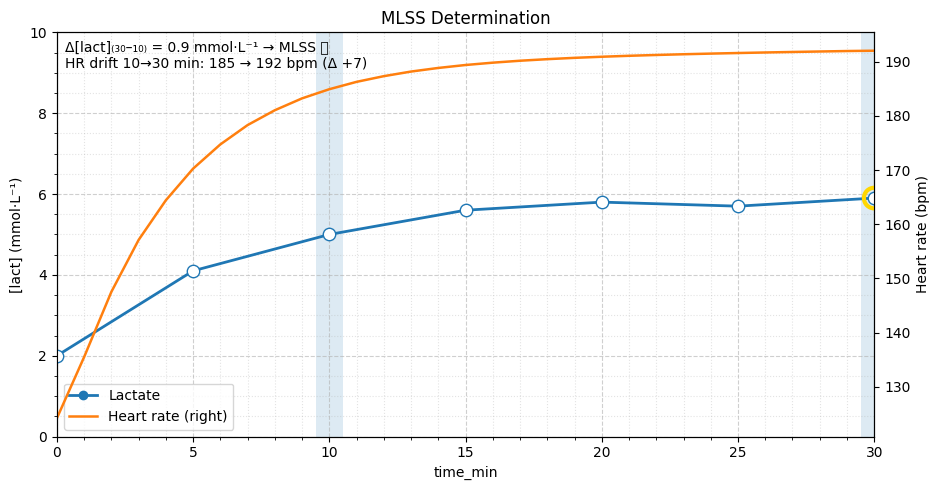
Lactate threshold heart rate (LTHR) is the heart rate that corresponds to your LT (also known as MLSS) pace or power.
Similar to LT, there are several accurate and easy ways to test and calculate your lactate threshold heart rate.
Learn more about it via our full article:
How to Calculate your Lactate Threshold Heart Rate (LTHR) — using threshold tests or training data
Athlete profile: aerobic diesel vs anaerobic turbo
A good triathlon plan takes your strengths and weaknesses into account.
Some triathletes are “diesels” with a typical endurance athlete profile: high aerobic power (VO2max), low anaerobic power (VLamax).
Others would be better described as “turbos”. They rely more on anaerobic power, and would probably benefit from a training program that increases aerobic power and decreases VLamax a bit.
This simplified diesel vs turbo example shows that a good training plan differentiates beyond level of experience and thresholds. It takes your athlete profile into account too.

“Diesels” rely on fat as a fuel, and are built for steady, long efforts. “Turbos” burn more carbs, and are built for hard efforts. Each needs a plan that matches their energy system.
The Aixsurge app does exactly that, by tailoring your plan, based on factors like VO2max, VLamax, anaerobic threshold and years of experience.
As a result, the app is able to understand why some triathletes are better off doing short vs long VO2max intervals.
Learn more about: Why Triathletes should better understand Anaerobic and Aerobic Capacity versus Power.
Individual training zones
Sure, most training programs use training zones. But are they up-to-date? And are they based on your sport specific threshold pace, power and heart rate? Resulting in separate zones for swimming, cycling and running?
You shouldn’t use the same heart rate zones for all sports.
|
Swimming |
Cycling |
Running |
|||
|
% LT speed |
% LT power |
% LTHR |
% LT speed |
% LTHR |
|
|
Zone 1 |
89 — 91% |
40 — 55% |
< 68% |
65 — 78% |
< 85% |
|
Zone 2 |
92 — 94% |
56 — 75% |
69 — 83% |
78 — 88% |
85 — 89% |
|
Zone 3 |
95 — 98% |
76 — 90% |
84 — 94% |
88 — 94% |
90 — 94% |
|
Zone 4 |
99 — 106% |
91 — 105% |
95 — 105% |
95 — 103% |
95 — 102% |
|
Zone 5 |
106 — 119% |
106 — 120% |
|
104 — 111% |
|
|
Zone 6 |
|
|
N/A |
|
N/A |
LT = lactate threshold, LTHR = lactate threshold heart rate
Once you have your personal, sport-specific thresholds, you can calculate your threshold training zones and calculate your heart rate training zones.
This allows you to turn your training zones into structured workouts, the building blocks of a highly individualized training plan.
But still, a training plan is much more than just a set of workouts.
3. Is it a training plan or just a set of workouts?
If you checked the first two boxes of the list, you know your destination (goal) and starting point (strengths and weaknesses). Now it’s time to map the route.
This requires a “helicopter view” strategy with elements like:
-
Periodisation: training cycles that decide when to focus on what specific goal.
-
Intensity distribution: should you focus on high intensity or high volume training?
-
Sport distribution: how much will you swim vs bike vs run?
Is your triathlon training program more than just a set of workouts in a random order? Here’s how to double check, and edit if necessary:
Periodisation: the fundament of a training plan
If there’s no clear periodisation, it’s not a training plan. Periodisation is as simple as breaking your preparation into distinct training cycles.
Training cycles allow you to focus on a specific physiological adaptation, based on the gap between your current strengths and weaknesses and the demands of your goal.
Training cycles should be ordered so each phase builds on the previous one. This is best done using:
-
Macrocycles (months), the helicopter view between each key race.
-
Mesocycles (weeks), a block designed to improve a specific physiological aspect.
-
Microcycles (single week), the actual week plan, containing workout and recovery days.
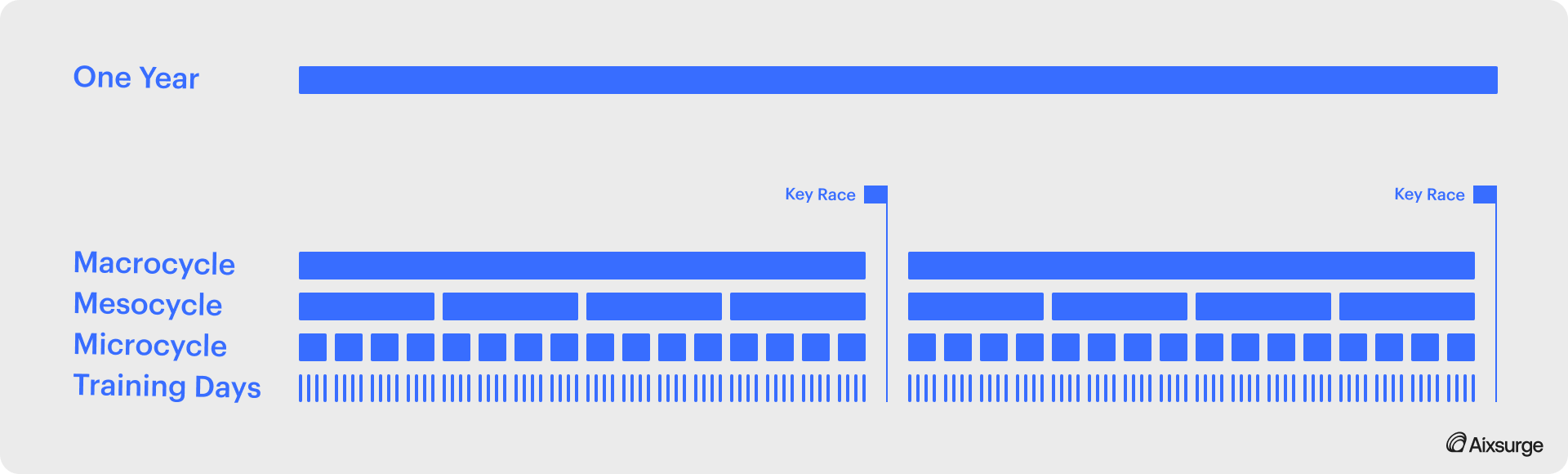
Here are 10 steps to apply periodisation in your triathlon training plan.
If you prefer to outsource your periodisation, and focus on training itself, an adaptive personal triathlon app like Aixsurge saves you the hassle.
Intensity distribution: polarized vs pyramidal vs HIT
At what training intensity should you spend most time? In zone 1, zone 2 or zone 3? A well thought out training plan answers this question on an individual level, and implements it on a macro level.
Polarized training is very popular. It’s a way of structuring training where most time is spent at low intensities (80-90%), a small amount at very high intensities (10-20%), and hardly any in the moderate middle zone.
However, research shows that most elite endurance athletes train pyramidal, not polarized.
Contrary to polarized training, pyramidal training contains a substantial amount of training time in the moderate middle zone.
Here’s a deep dive in how pro triathletes train.
But actually, the only thing that matters is what training model works best for you. Here are 3 factors that determine which training method is best for you:
Should triathletes train polarized, pyramidal or threshold?
Use it to design your training plan.
Sport distribution: what sport to focus on?
How much time you train per sport should differ based on your personal capabilities. The triathlon distance and whether you’re allowed to draft also determine which sport gives you the most bang for your buck.
For example, some triathletes get huge gains from a small improvement in swimming, simply because it helps them stay out of the chaos. Others are prone to running injuries, so they are better off replacing some run miles for time on the bike.
Does your training plan take your sport specific capabilities into account?
Here are interesting stats on how many hours pro triathletes spend on swimming, cycling and running.
4. Does your program follow proven physiological principles?
You can have a beautiful triathlon training plan, tailored to your goal, fitness and desired outcomes, but is it realistic?
Ambitious plans need to follow proven physiological principles. For instance:
-
Progressive overload: increase training volume and intensity, step by step.
-
Supercompensation: your body only adapts to training, with sufficient recovery.
Let’s double check whether your plan lives by these principles.
Progressive overload: one step at a time
A well designed training program increases volume or intensity one step at a time, starting from a training load you’re currently comfortable with.
Jumps in training load can easily lead to injuries, demotivation or overtraining.
Progressive overload is the act of adding training stress, step by step. Here’s a visualisation of how progressive overload looks like in a training program. Note the build and recovery pattern.
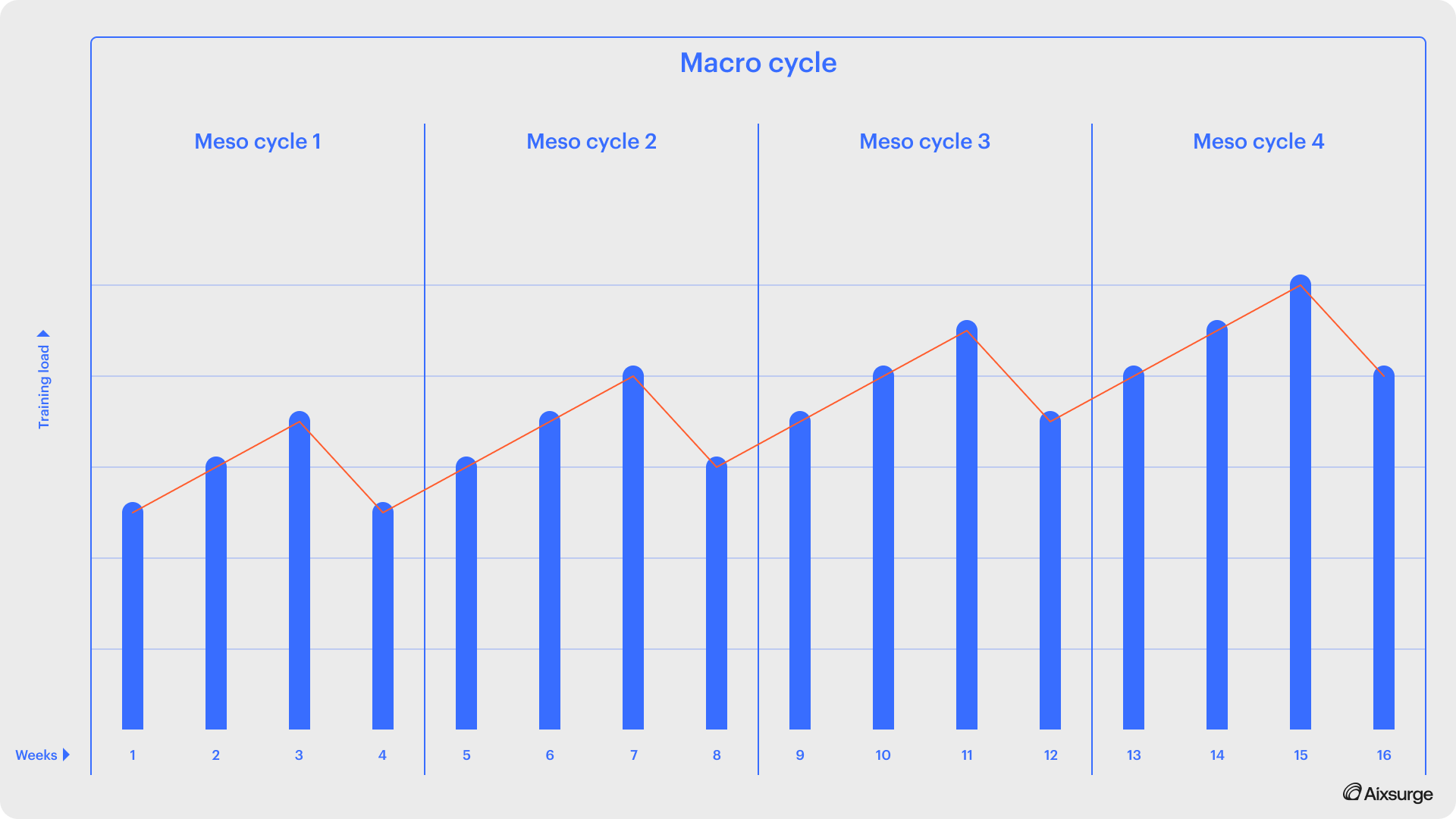
Your training plan should have a similar pattern. You can easily check for this pattern, looking at historical data or planned workouts.
Training > Recovery > Supercompensation
Every triathlete should understand supercompensation. It’s the physiological process of improved fitness after training, provided adequate recovery.
A single workout results in 4 supercompensation phases, shown in the image:
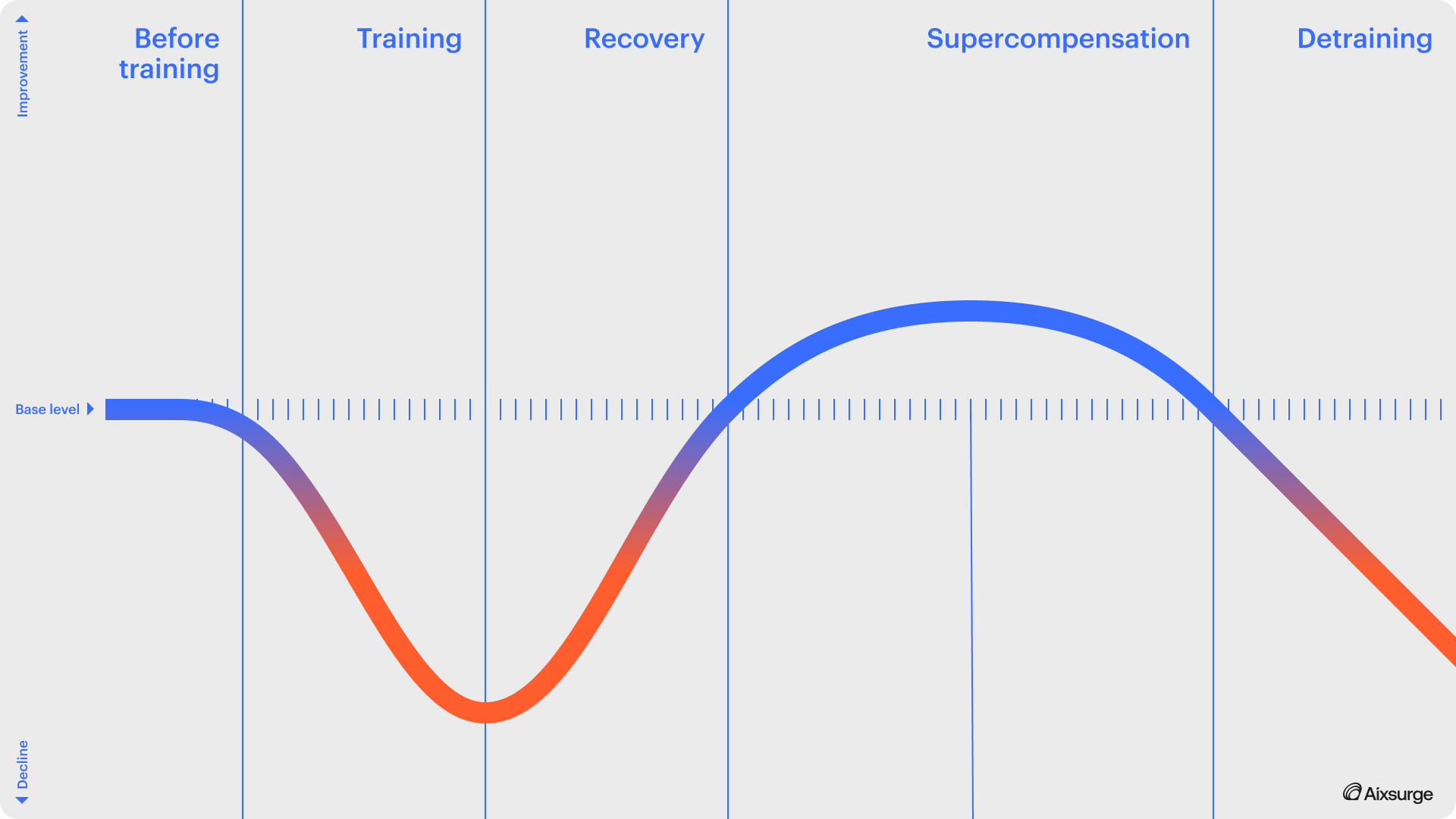
The goal is to plan the next triathlon workout when your body is in the supercompensation phase. If you train too early, you have not benefited from the positive effect of training yet. If you train too late, the positive effect of your previous training is already diminished, as shown in this image:
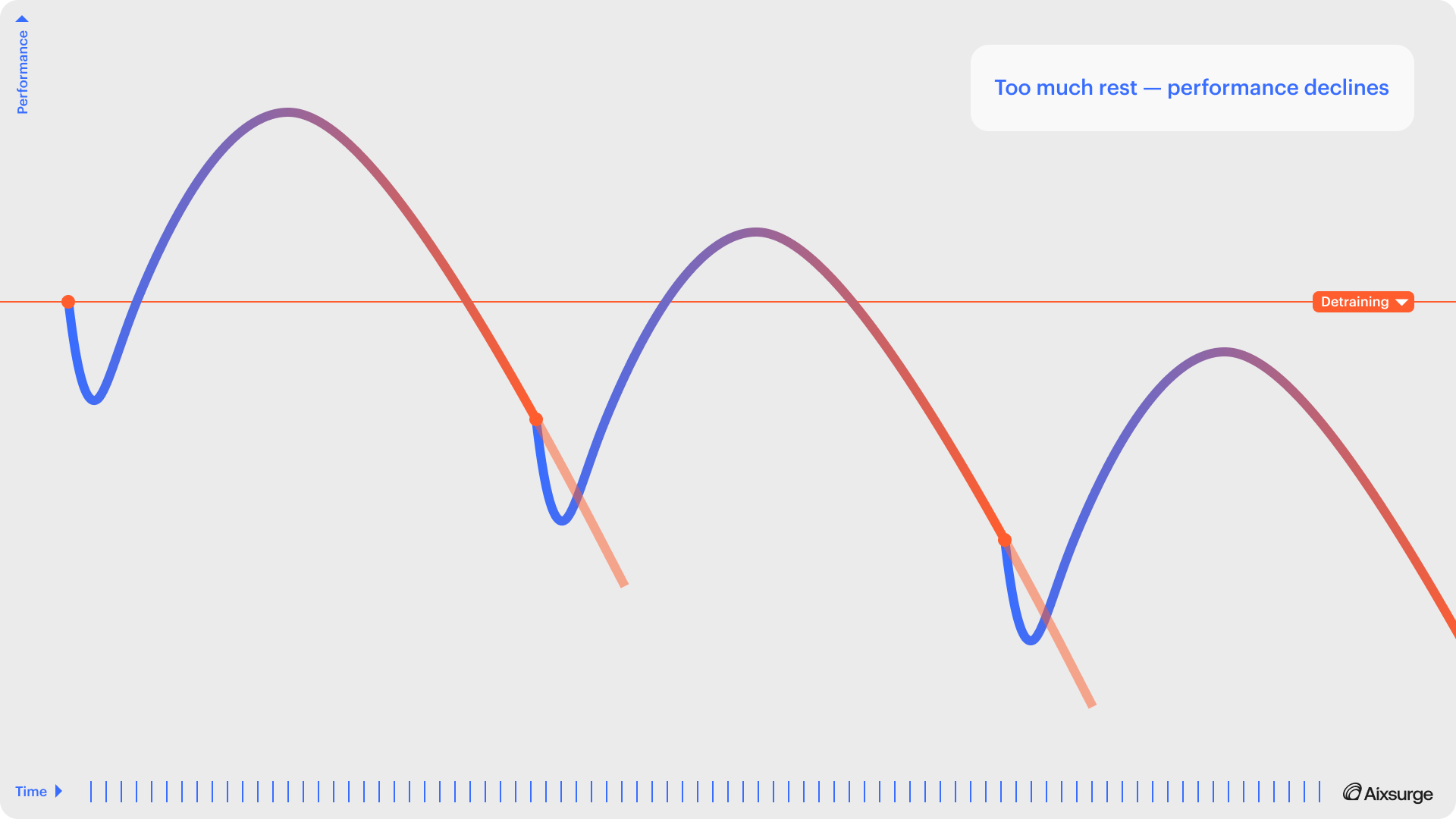
The supercompensation theory shows that an effective training program balances training and recovery, using precise timing. Poor timing can quickly lead to detraining or overtraining, while good timing can result in fast jumps in fitness.
Learn more about: Using supercompensation in your training plan
5. Does your plan have a feedback loop — so it can adapt?
Here’s why most triathlon training programs fail: they don’t adapt.
A plan looks great on paper, until real life happens. So ask yourself: what does your plan do when you miss a workout? When you wake up with a sore throat? When work stress spikes? Or when a training block clearly isn’t landing the way it should?
If it doesn’t adapt, it’s not a training plan, it’s a free PDF.
Regular progress tests that update your thresholds and training zones are a good starting point.
If you don’t want to rewrite your plan after every bump in the road, try a triathlon training app like Aixsurge. It dynamically adjusts your triathlon training plan to harmonize with your life.
6. Does your program prepare for the event?
If your tri program checked all the boxes so far, you’re almost there. Last but not least: race prep. Let’s separate 3 aspects:
-
Tapering: the act of boosting your fitness in the final weeks before the event
-
Race simulation: preparing for what’s about to come
-
Race strategy: knowing what to do on race day, from pacing to nutrition
This is where all puzzle pieces should fall into place.
Tapering: reaching peak form
The last week (s) before your event are crucial. They make or break your preparation. Therefore, your training program better contains a well-designed final part, the taper.
If you train too much in the final weeks, you’ll start your event feeling fatigued. The contrary is maybe even more common: if you rest too much, you’ll lose a significant portion of the fitness you worked so hard to build.
It goes beyond the scope of this article to dive into the details of a good taper, but it better be part of your training program.
By using the Aixsurge triathlon training app, you can skip the theory and go straight to practice. The app finishes all training plans with a personalized taper, based on recent sport science literature.
Race simulation
This brings us back to the first item on the checklist: having a training plan that is goal specific.
Simulating race situations in training should be part of your plan. Not only in the final weeks. While some are mainly rehearsals, like practicing transitions, others are truly part of physical training. For example:
-
Cover the event distance (per sport)
-
Train at your target intensity
-
Train your gut to absorb nutrition during exercise
-
Acclimatize to race conditions (heat, humidity, altitude)
-
Get familiar with course demands, like climbs and open water
-
Include brick workouts
To simulate your race, you need to know your race strategy.
Race strategy
If you decide on your race strategy in the days prior to the event, you can’t prepare for it in training. That’s why starting with the end in mind gives you an advantage.
For example: know roughly what intensity you’re aiming to hold, and how you plan to fuel for it. This allows you to practice and adjust during training, instead of improvising on race day.
Wrap-up
Did your plan pass the entire checklist? Great! You’re ahead of most triathletes.
Missed a checkbox here and there? Also great! There’s room for improvement. Best part: you probably don’t need to train harder to get better results, you only need a plan that fits you better.
If you’d rather focus on training instead of constantly tweaking your plan, try Aixsurge. You’ll get a bespoke training plan that dynamically adapts as you go, so it stays in sync with your fitness and your life.

Jump straight to: