
Missed workouts or about to miss workouts? Do this.
How much fitness do you lose when missing workouts?
How much fitness you lose after missing several workouts depends on… the duration of training cessation. It also depends on your training history: highly trained triathletes lose fitness quickly, while less experienced triathletes are less affected.
This seems to mirror the law of diminishing returns in training: the closer you are to your performance ceiling, the harder it becomes to improve it, and the easier it is to lose it.
The loss of fitness resulting from missed workouts is called detraining. Physically, detraining is very predictable, because it essentially reverses training induced adaptations. For example, detraining leads to a decrease in:
-
Fat metabolism, resulting in a higher reliance on carbohydrate
Detraining should not be confused with a taper week, which is a planned reduction in training load, designed to reduce fatigue and improve performance.
So how fast does performance decrease after missing workouts? And how to respond?
You’ve missed a workout or two
Fitness loss after missing a workout
Detraining is unlikely to take place after missing a workout or two. There’s no reason to expect a decrease in metrics like VO2max or lactate threshold power.
In fact, the additional rest can work in your favor, similar to a taper week.
That said, consistency in training is what builds triathlon fitness. That’s why you don’t want to miss workouts regularly. So what do you do after missing a workout or two?
Should you reschedule a missed workout?
In general, you should not try to reschedule a missed workout. It is more likely to mess up whatever’s coming than catch up what’s already lost.
When in doubt about rescheduling a missed workout, always ask yourself 3 questions:
-
When did I miss the workout?
-
Why did I miss the workout?
-
What workout did I miss?
When was the workout planned? In pre-race week or build phase? This can determine whether you want to reschedule it. If it was in the build phase, you’ve got plenty of time to work towards your goal anyway. Don’t disrupt the next three workouts by rescheduling the missed one.
Why did you miss the workout? Due to family weekend or illness? If it’s the latter, you are way better off taking the next workouts easy instead of squeezing in the missed workout.
What workout did you miss? A key interval session that targets a specific adaptation? This can be an exception to the rule. You might want to consider replacing the next workout with the missed workout.
When in doubt: forget about the missed workout and proceed normally. Need a second opinion? Download the Aixsurge triathlon app. It handles missed workouts automatically by slightly adapting the program, depending on your physiology and training block.
You’ve missed a workout week
Fitness loss after a week without training
A week off is where your body actually starts to change, but the losses are smaller and slower than the panic in your head suggests.
Yes blood volume starts dropping and therefore heart rate creeps up. Yes VO2max can start to show a small decrease. And yes your body is nudged to burn more precious carbs and less fat at a given effort.
Assuming it’s not a planned taper week, you should try to prevent skipping all triathlon workouts during a week. Being aware of the reason you had to skip a full training week is probably the most important part here. Because it allows you to prevent it from happening in the future.
And still it is very common that this will happen at some point in your training program. So what do you do?
Should you reschedule a missed training week?
It should be obvious not to cram seven days of training into the next seven. This would be the fastest way to turn a missed week into a missed month.
Again, the general advice would be to consider the missed week as an unplanned recovery week, picking things up where you left off. How you actually proceed depends on the previously stated questions: when did you miss a week, why did you miss it, what workouts did you miss?
If you missed an entire training week, close to a planned recovery week, you can consider shortening or adjusting the planned recovery week. Except when you missed a week due to illness. In that case, you should actually ease in, instead of picking up where you left off.
Ideally, you do some small changes to the week (s) after your missed week, based on the answers of the three questions. Aixsurge helps you do exactly that. The biggest advantage? You don’t have to worry about a missed week, for weeks to come.
Although specific literature is missing, the small losses in fitness after a week without training are likely retrained after 1-2 weeks. The deeper adaptations you built over months were never lost after all.
You’ve missed two training weeks
Fitness loss after missing two workout weeks
So you’ve lost 10-14 days of training. Oops.
How much fitness did you lose? A controlled study on endurance-trained athletes measured exactly this. 2 Weeks of detraining produced a significant drop in VO2max and maximal stroke volume. The 'time to exhaustion' during a running test dropped as well. This lines up with other studies that show highly trained athletes show a drop in VO2max of about 4 to 7%, within the first two weeks of detraining.
It’s a decrease you’re very likely to feel on the first sessions back in training. Especially if you had to skip two weeks of training due to illness.
Now what?
How to proceed after missing two weeks of training?
When you miss a single workout or two, you ignore it. When you miss an entire week, you treat it as an unplanned recovery week and start where you left off. But what about missing two weeks of training? The script changes significantly.
Stop thinking about the workouts you lost and start thinking about how you come back. This is a return protocol, not a catch-up plan. In practice, that means you can’t pick up where you left. You need to adjust intensity and volume for the first sessions, and start below where you left off.
While doing so, tune in more often to feel and heart rate as your guide. Acknowledge that your lactate threshold heart rate is probably up by a couple of beats. If it feels harder than it should, your body is still catching up. Respect it. Especially if illness caused the break.
This is precisely the moment where guessing gets expensive, ramp too fast and you get hurt, ramp too slow and you waste fitness you could have reclaimed. Aixsurge builds the return for you: after a two-week gap it reconstructs your plan around your current physiology, easing you back at the right load instead of dumping you back into the program you abandoned a fortnight ago.
That said, let’s not exaggerate or panic either. Encouragingly, research on athletes who took two weeks off found their lost performance recovered within about two weeks of structured retraining.
Missed more than two weeks?
Beyond two weeks, the losses keep compounding. The longer the gap, the more your return becomes a genuine rebuild rather than a quick top-up. That’s a different problem with a different playbook.
You have to reconsider your entire training periodisation (macro, meso, micro training cycles). Don’t forget to update your training zones too, recalculating threshold heart rate and threshold power/pace.
At some point, you might even need to accept that your triathlon goal (e.g. triathlon pacing plan) needs to be adjusted.
When in doubt, reach out to your coach. Or simply use the Aixsurge triathlon app, which gives you a bespoke triathlon training plan that adapts to any missed workout, to harmonize with your life.
You’re about to miss a workout. What to do?
Sometimes you can see it coming. You’re about to miss one or more planned workouts due to a work trip or family weekend. Knowing beforehand allows you to prepare for it.
In a busy workout schedule, you might not need to act at all. Some additional recovery due to work or family obligations could be exactly what you need.
If you’re about to miss several workouts in the span of a week or more, it starts to make sense to act. But how? Literature supports two options:
-
Pre-loading: adding additional training load before your missed workouts.
-
Minimal dose: skip the volume, keep the intensity.
Pre-load before missing workouts
Missing workouts over the course of a week or more is very similar to a taper week, in which you deliberately back off training. Taper studies show that pre-loading (adding additional training load before the taper week) can result in better performances after the taper week.
It works like supercompensation: the hard block causes fatigue, the recovery results in adaptation.
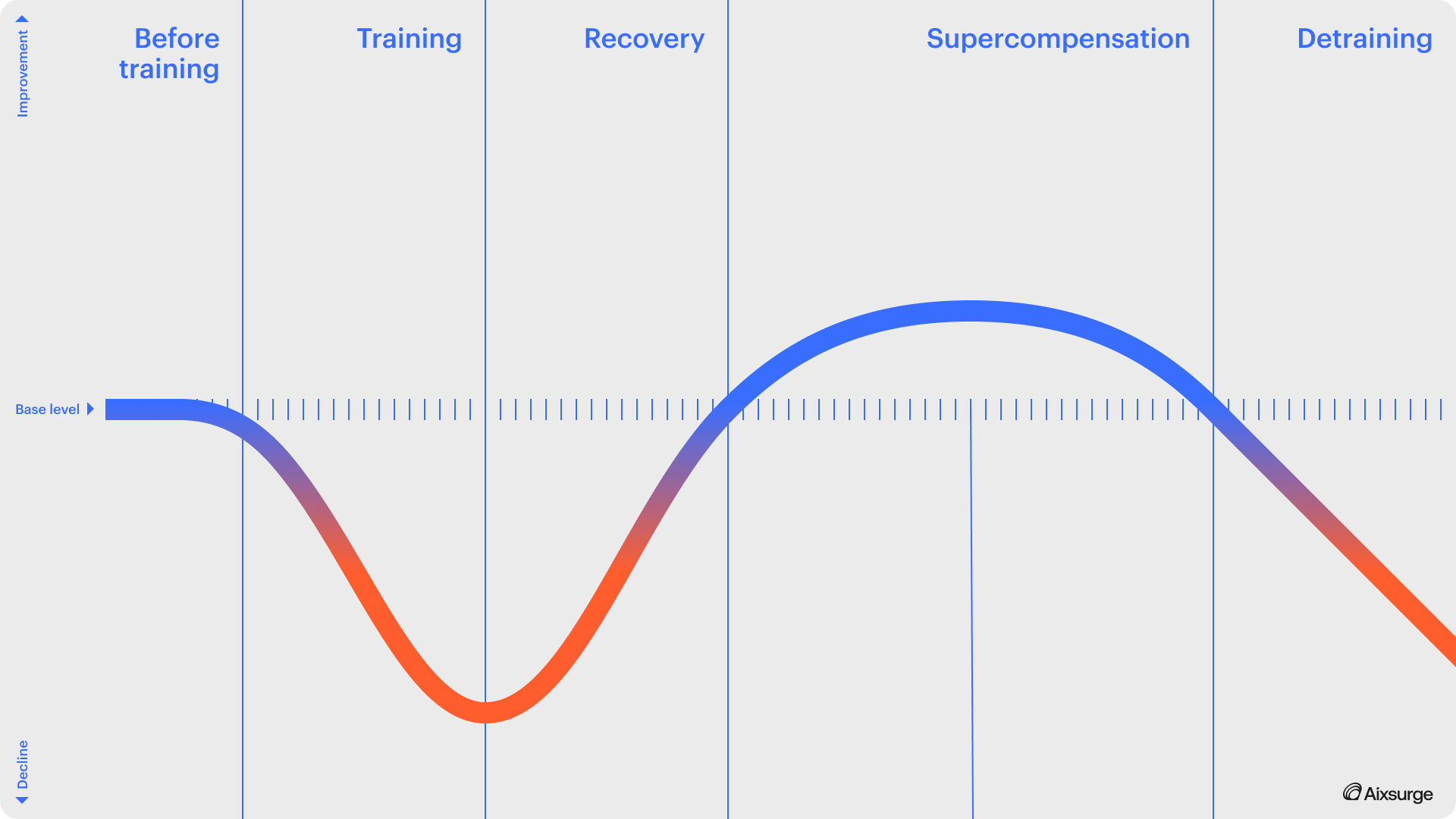
So if you know a quiet stretch is coming that’s long enough to act like a taper, nudge up the quality of your training in the days before it.
Maintain minimal dose when missing workouts
If you have the luxury to squeeze in some workouts during a period in which you can’t fully commit to your training program, make sure to focus on the right workouts.
Literature is very clear on what to do. And luckily, it matches well with a time restricted week or two.
When looking for the minimal dose to maintain fitness: protect intensity, cut volume. In other words, do your interval training and don’t worry about your low intensity workout. You can maintain performance, even when training volume drops by 40-60%, as long as you continue your intensity intervals.
Do short sessions, but don’t soften them.
Conclusion: dealing with missed workouts
Consistency is king, and yet missing workouts is reality. Over a season, the average triathlete adjusts their program again and again, and missed workouts are just one reason among many.
The goal is not to never miss a workout. The goal is to always adjust well and keep going.
The challenge is that adjusting well can be genuinely hard. Even with the science based advice in this article. That is because every situation and every athlete is different.
That’s exactly where the Aixsurge app can help. Instead of rewriting your program every time life interferes, or second-guessing whether you’re doing the right thing, you let the plan adapt around you. Aixsurge allows you to focus on training.
Literature
A week off results in a drop in blood volume, increase in heart rate and a small decrease in VO2max. You’ll start burning more carbs and less fat, at a given effort.
- MUJIKA, IÑIGO; PADILLA, SABINO. Cardiorespiratory and metabolic characteristics of detraining in humans. Medicine and Science in Sports and Exercise 33(3):p 413-421, March 2001. https://journals.lww.com/acsm-msse/fulltext/2001/03000/cardiorespiratory_and_metabolic_characteristics_of.13.aspx
2 Weeks of detraining produced a significant drop in VO2max and maximal stroke volume. The 'time to exhaustion' during a running test dropped as well.
- Chen, Y. T., Hsieh, Y. Y., Ho, J. Y., Lin, T. Y., & Lin, J. C. (2022). Two weeks of detraining reduces cardiopulmonary function and muscular fitness in endurance athletes. European Journal of Sport Science, 22(3), 399–406. https://doi.org/10.1080/17461391.2021.1880647 https://www.tandfonline.com/doi/citedby/10.1080/17461391.2021.1880647
Highly trained athletes show a drop in VO2max of about 4 to 7%, within the first two weeks of detraining.
- MUJIKA, IÑIGO; PADILLA, SABINO. Cardiorespiratory and metabolic characteristics of detraining in humans. Medicine and Science in Sports and Exercise 33(3):p 413-421, March 2001. https://journals.lww.com/acsm-msse/fulltext/2001/03000/cardiorespiratory_and_metabolic_characteristics_of.13.aspx
Pre-loading (adding additional training load before the taper week) can result in better performances after the taper week.
- THOMAS, LUC; BUSSO, THIERRY. A Theoretical Study of Taper Characteristics to Optimize Performance. Medicine & Science in Sports & Exercise 37(9):p 1615-1621, September 2005. | DOI: 10.1249/01.mss.0000177461.94156.4b https://journals.lww.com/acsm-msse/fulltext/2005/09000/a_theoretical_study_of_taper_characteristics_to.23.aspx
When looking for the minimal dose to maintain fitness: protect intensity, cut volume.
- Mujika, Iñigo. (2011). Tapering for triathlon competition. Journal of Human Sport and Exercise. 6. 10.4100/jhse.2011.62.06. https://www.researchgate.net/publication/228477258_Tapering_for_triathlon_competition