Training for a Triathlon: How much time does it take
A common hearing within the triathlon community is that it takes 10-15 training hours per week to train for a triathlon [1]. This blog will provide a critical evaluation of this assumption and instead argue that the time required to train for a triathlon is highly individual and dependent on numerous factors that may substantially decrease, or increase the required training time.
Factors influencing training time
Baseline fitness levels, race distance, and desired performance level are arguably the most important factors determining the required training time. A lower baseline fitness level, longer distances, and higher aspirations necessitate larger training volumes.
If you have a reasonable baseline fitness level, do not have the aspiration to be a world-class athlete, and if you are opting for the Olympic distance, you could well perform a triathlon with for example only 5 training hours per week. In contrast, even the (shorter) Olympic distance may require you to complete a large number training hours (potentially even >20 hours per week!), if you aspire to be among the best athletes, even if your baseline fitness is already good. Let’s see some science behind the reasoning above.
The volume-Performance Conundrum
A mentioned before, the time commitment for triathlon training is intricately linked to your performance goals. The reason for this is that multiple studies have shown higher training volumes to be associated with better performance in for example running [2-4], cycling [5], or overall triathlon performance [6, 7]. However, the relationship is not always linear but instead sometimes follows a logarithmic relationship, whereby larger volumes have increasingly less beneficial effects on performance. Nevertheless, Figure 1 from a study among runners does suggest a largely linear trend. In this study among elite runners [2], the total volume of distance ran in training was a strong predictor of their IAAF performance scores and explained up to 59% of performance score variability between athletes.
There are however also studies that do not confirm the importance of a higher volume to performance. For example, in a classic study by David Costill [8], swimmer were divided into two groups: one group continued their normal training with one 1.5 h session per day for 6 weeks, while the other group trained twice a day for 1.5 hours per session over the 6-week period, and thus doubled their training volume. After another 14 weeks of training only once a day, both groups showed an equal improvement in performance, thus suggesting the additional training volume was not beneficial. Similarly, another study specifically among non-professional triathletes showed only weak and non-significant correlations between a higher training volume and better performance [9].
So what should I take from these research findings?
My take from all these studies is that while a higher volume does not always improve performance, your best bet from all studies is that it will be of benefit, especially if your current volume is not that high to begin with. Indeed, it is hard to find a study that shows a larger volume is detrimental. So it may not benefit in the worst case, but likely be of benefit to most athletes. However, the relationship may not always be strong for reasons explained below.
Adaptations take time
One of the reasons why a higher volume may not always benefit performance is that it will take time for your body to adapt to such a high training volume. Therefore, it is important to gradually build up towards a higher volume, if desired. Further, the training volume needs to be sustainable over prolonged training periods as consistency in training over multiple weeks and months of training will eventually build a much better performance than a very short period of higher volume training. Doing two weeks of a very high volume training followed by three weeks of very low volume training due to injuries or fatigue will not optimize, but rather impair your performance [10].
You will need sufficient energy
A second reason why a high volume may not always be beneficial is that you will need to get in sufficient energy, and specifically carbohydrates to fuel all training [11]. Doing a large volume of training burns a large number of calories [12, 13], and your body will need to get sufficient calories to ensure it can keep producing sufficient energy to complete each workout, and -most importantly- adapt to it.
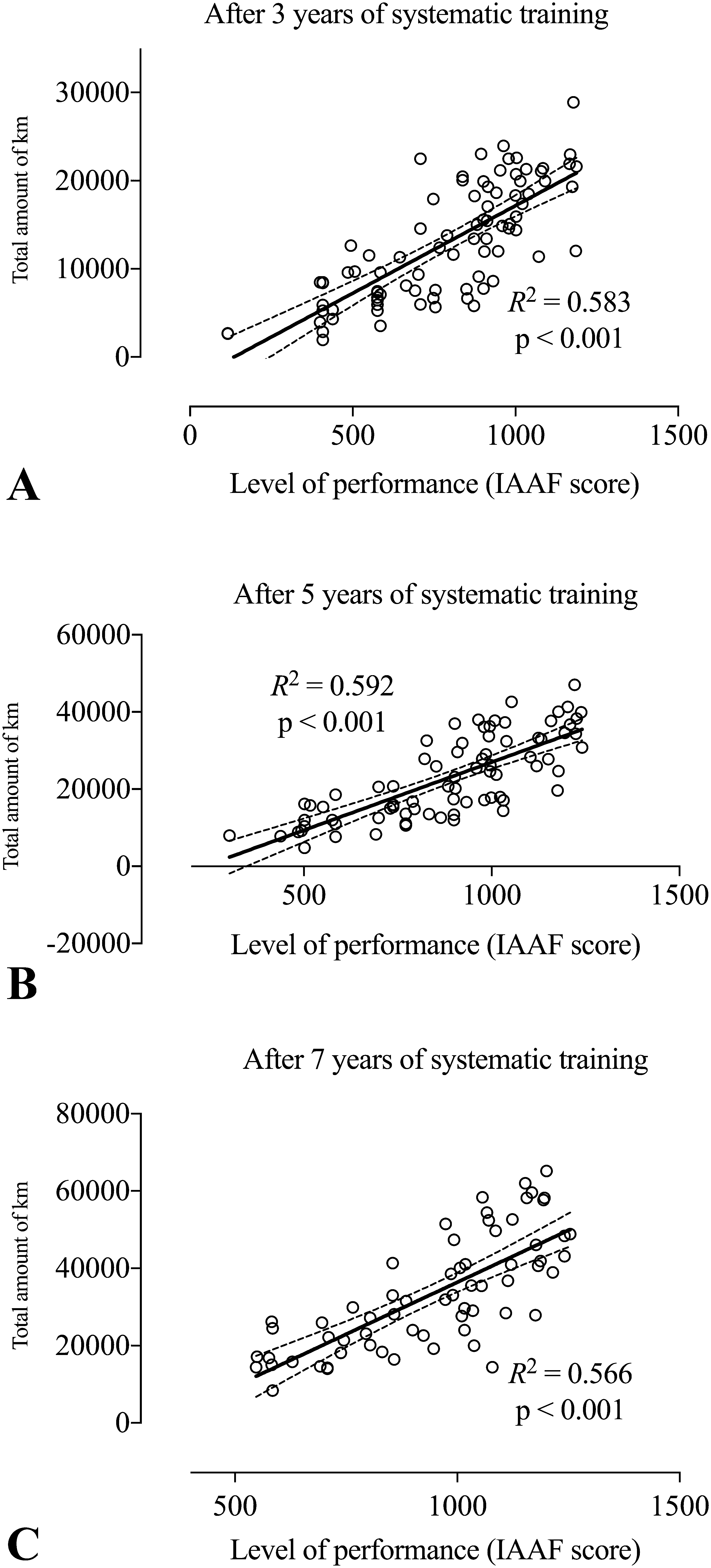
Figure 1. Relationship between IAAF performance scores and 3, 5 and 7-year training volume in runners. From [2].
What you do in those hours matters
Finally, a third reason why volume or the number or training hours is not always correlated with performance is that the way in which you spend these hours is also important. For example, a growing body of research shows that post-exercise active recovery (i.e., low intensity cool-down) [14] does likely not meaningfully contribute to performance improvements or injury reduction. Similarly, various warm-up activities such as walking with a light-weight elastic band around your knees or ‘glute activation exercises’ are unlikely to meaningfully impact your performance or injury risk [15]. So if you spend 30 minutes of your 60-minute training session on a warm-up and cool-down, only a part of that time may actually contribute to improving your performance. Spend your time wisely!
What do the best triathletes do in their training?
Hopefully by now you are convinced that 1) a higher volume will likely benefit your performance, but also that 2) what you actually do during those training hours matters (a lot!). So what should you be doing during these training hours? For example, how hard should you be training?
Long distance endurance events such as an Ironman are typically performed at intensities close to an athlete’s individual second lactate threshold or second ventilatory threshold (also known as respiratory compensation point, or sometimes [incorrectly] referred to as anaerobic threshold) [7]. However, observational studies on the training intensity distribution in various elite endurance athletes, including triathlon, show a strong focus on training at low-to-moderate intensities below the first ventilatory threshold/first lactate threshold, with most of the remaining training time targeting high-intensity training at near-maximal and supramaximal intensities [7, 16, 17]. This format of polarized training intensity distribution is often considered best practice to maximize adaptation at acceptable levels of physiological stress [18], although there is some ongoing debate on this.
In support of the polarized concept, the training time spent in zone 1 (below the first ventilatory point/ first lactate threshold) has been associated with a better Ironman performance, whereas the time spent in zone 2 actually had a negative association with performance [7]. While there are various potential reasons for this differential association, it is well known that training in zone 2 for prolonged periods could lead to undesirable effects such as glycogen depletion [19], prolonged cardiac parasympathetic recovery [20], and/or higher overall central and muscular fatigue [21], all of which may adversely affect performance and recovery. Similarly, another study in professional cyclists found that the time spend training below the first ventilatory threshold/a polarized training intensity distribution was associated with a better ability to maintain cycling power over longer durations (i.e., better durability) [22].
The evidence therefore shows you don’t need to train very hard or exhaust yourself during every session! In fact doing so, may reduce rather than increase your performance. Instead, do most of your sessions at a relatively easy intensity, and some of them (typically 1-2 per week) at a higher intensity.
Do these findings also hold for lesser trained individuals?
One important caveat to all the findings discussed in the previous section is that they come mostly from elite athletes, so you may wonder if the same effect is found in lesser trained individuals that are not training 20 hours a week. Specifically, some individuals argue that these findings don’t translate well to those who can only train four to six hours per week because these individuals just can’t accumulate enough training stress to see gains with a predominantly low intensity approach.
Studies among recreational athletes that compared the effectiveness of polarized and threshold training however also often show polarized training to be more effective than threshold approaches whereby more sessions are performed at a moderately high intensity [23-25]. Thus, also for recreational triathletes, the polarized approach with most sessions at a low intensity, and only 1-2 sessions at higher intensity may lead to optimal results.
Do recreational triathletes use this approach?
In this context, it is interesting to note that lesser trained individuals are often training at a relatively harder intensity than better trained individuals [26]. A potential reason for this is that they try to replicate the higher wattages on the bike, higher running speed, and higher swimming speed used by elite athletes in their training. However, by doing so they forget that these higher wattages and speeds are often still relatively easy for these elite athletes (below their first ventilatory or lactate threshold), while being much more intense for non-elites (above their first ventilatory or lactate threshold). As an example, a world-class female Olympic distance triathlete performed 74%, 88%, and 85% of her swim, bike, and run training, respectively, at intensities below her individual first lactate threshold over an entire season [16].
Conclusion
The time required to train for a triathlon is highly individual and dependent on numerous factors such as baseline fitness levels, race distance, and desired performance level. Further, how each training hour is spend also determines whether it will actually contribute to performance, with most of the sessions being relatively easy sessions and 1-2 sessions per week being a harder session likely producing good results for most athletes.
References
-
Freeman A. How Much Time Does it Take to Train for a Triathlon? 2022. https://www.triathlete.com/training/how-much-time-does-it-take-to-train-for-a-triathlon/.
-
Casado A, Hanley B, Santos-Concejero J, Ruiz-Perez LM. World-Class Long-Distance Running Performances Are Best Predicted by Volume of Easy Runs and Deliberate Practice of Short-Interval and Tempo Runs. J Strength Cond Res. 2021;35(9):2525-31. doi:10.1519/JSC.0000000000003176.
-
Haugen T, Sandbakk O, Seiler S, Tonnessen E. The Training Characteristics of World-Class Distance Runners: An Integration of Scientific Literature and Results-Proven Practice. Sports Med Open. 2022;8(1):46. doi:10.1186/s40798-022-00438-7.
-
Emig T, Peltonen J. Human running performance from real-world big data. Nature communications. 2020;11(1):4936.
-
Jeukendrup AE, Martin J. Improving cycling performance: how should we spend our time and money. Sports Med. 2001;31:559-69.
-
Leake CN, Carter J. Comparison of body composition and somatotype of trained female triathletes. J Sports Sci. 1991;9(2):125-35.
-
Munoz I, Cejuela R, Seiler S, Larumbe E, Esteve-Lanao J. Training-intensity distribution during an ironman season: relationship with competition performance. Int J Sports Physiol Perform. 2014;9(2):332-9. doi:10.1123/ijspp.2012-0352.
-
Costill D, Thomas R, Robergs R, Pascoe D, Lambert C, Barr S et al. Adaptations to swimming training: influence of training volume. Med Sci Sports Exerc. 1991;23(3):371-7.
-
Knechtle B, Wirth A, Baumann B, Knechtle P, Rosemann T, Oliver S. Differential correlations between anthropometry, training volume, and performance in male and female Ironman triathletes. J Strength Cond Res. 2010;24(10):2785-93.
-
Raysmith BP, Drew MK. Performance success or failure is influenced by weeks lost to injury and illness in elite Australian track and field athletes: A 5-year prospective study. J Sci Med Sport. 2016;19(10):778-83. doi:10.1016/j.jsams.2015.12.515.
-
Stellingwerff T, Heikura IA, Meeusen R, Bermon S, Seiler S, Mountjoy ML et al. Overtraining Syndrome (OTS) and Relative Energy Deficiency in Sport (RED-S): Shared Pathways, Symptoms and Complexities. Sports Med. 2021;51(11):1-30. doi:10.1007/s40279-021-01491-0.
-
Van Hooren B, Cox M, Rietjens G, Plasqui G. Determination of energy expenditure in professional cyclists using power data: validation against doubly‐labelled water. Scand J Med Sci Sports. 2022;33(4):407-19.
-
Van Hooren B, Most J, Collombon E, Nieminen H, Plasqui G. A new approach to improve the validity of doubly labelled water to assess CO2 production during high energy turnover. Medicine and Science in Sport and Exercise. 2021;Epub ahead of print.
-
Van Hooren B, Peake JM. Do We Need a Cool-Down After Exercise? A Narrative Review of the Psychophysiological Effects and the Effects on Performance, Injuries and the Long-Term Adaptive Response. Sports Med. 2018;48(7):1575–95. doi:10.1007/s40279-018-0916-2.
-
McMahone G. What do “activation” or “pre-activation” exercises actually do? Anything? 2023. https://www.sportsmith.co/articles/what-do-activation-or-pre-activation-exercises-actually-do-anything/.
-
Mujika I. Olympic preparation of a world-class female triathlete. Int J Sports Physiol Perform. 2014;9(4):727-31.
-
Etxebarria N, Mujika I, Pyne DB. Training and competition readiness in triathlon. Sports. 2019;7(5):101.
-
Seiler S. What is best practice for training intensity and duration distribution in endurance athletes? Int J Sports Physiol Perform. 2010;5(3):276-91. doi:10.1123/ijspp.5.3.276.
-
Beneke R, Leithauser RM, Ochentel O. Blood lactate diagnostics in exercise testing and training. Int J Sports Physiol Perform. 2011;6(1):8-24. doi:10.1123/ijspp.6.1.8.
-
Stanley J, Peake JM, Buchheit M. Cardiac parasympathetic reactivation following exercise: implications for training prescription. Sports Med. 2013;43(12):1259-77. doi:10.1007/s40279-013-0083-4.
-
Brownstein CG, Pastor FS, Mira J, Murias JM, Millet GY. Power Output Manipulation from Below to Above the Gas Exchange Threshold Results in Exacerbated Performance Fatigability. Med Sci Sports Exerc. 2022;54(11):1947-60. doi:10.1249/MSS.0000000000002976.
-
Spragg J, Leo P, Swart J. The relationship between training characteristics and durability in professional cyclists across a competitive season. Eur J Sport Sci. 2023;23(4):489-98.
-
D’Alleva M, Giovanelli N, Graniero F, Billat VL, Fiori F, Marinoni M et al. Effects of 24‑week polarized training vs. threshold training in obese male adults. Int J Sports Med. 2023;00(AAM). doi:10.1055/a-2123-0851.
-
Muñoz I, Seiler S, Bautista J, España J, Larumbe E, Esteve-Lanao J. Does polarized training improve performance in recreational runners? Int J Sports Physiol Perform. 2014;9(2):265-72. doi:10.1123/ijspp.2012-0350.
-
Carnes AJ, Mahoney SE. Polarized versus high-intensity multimodal training in recreational runners. Int J Sports Physiol Perform. 2019;14(1):105-12.
-
Altini M. how hard do you train? 2016. https://www.hrv4training.com/blog/how-hard-do-you-train.