Running form: what is optimal for performance enhancement and injury prevention?
Athletes and coaches often spend numerous hours optimizing running form with the aim to enhance running performance and reduce running injury risk. There is however much discussion around the optimal running form, with many different approaches having been proposed (e.g., Pose running, natural running, etc.).
Due to all these different approaches it can be difficult to discern marketing from truth. This blog will therefore provide an evidence-based overview of the relation between running form and running performance, and running form and running injury risk.
Running form and running economy
Running form has been shown to have an important influence on running performance (Folland et al., 2017), or proxies of running performance such as running economy (i.e., the amount of oxygen or energy used to run at a given speed) (Van Hooren, Jukic, et al., 2024). For example, running form can explain up to 54% of the variability in running economy between individuals, and up to 94% of the variability in the change in running economy within individuals over time (Van Hooren, Jukic, et al., 2024).
Although multiple studies have investigated the association between running form and running economy, the evidence often remained inconclusive or even conflicting. Some studies for example reported rearfoot striking to be associated with a better running economy [32, 23], while other studies reported fore-/mid-foot striking to be associated with a better running economy [33, 24]. Yet other studies reported no differences in running economy between runners with different footstrike patterns [34, 35]. In a recent comprehensive systematic review with meta-analysis I have summarized all studies that investigated the relationship between running form and running economy in an attempt to clarify the most economical way to run (Van Hooren, Jukic, et al., 2024). The most important findings of this review are shown in Figure 1. I will summarize the key findings in the sections below, and thereafter discuss some potential implications.
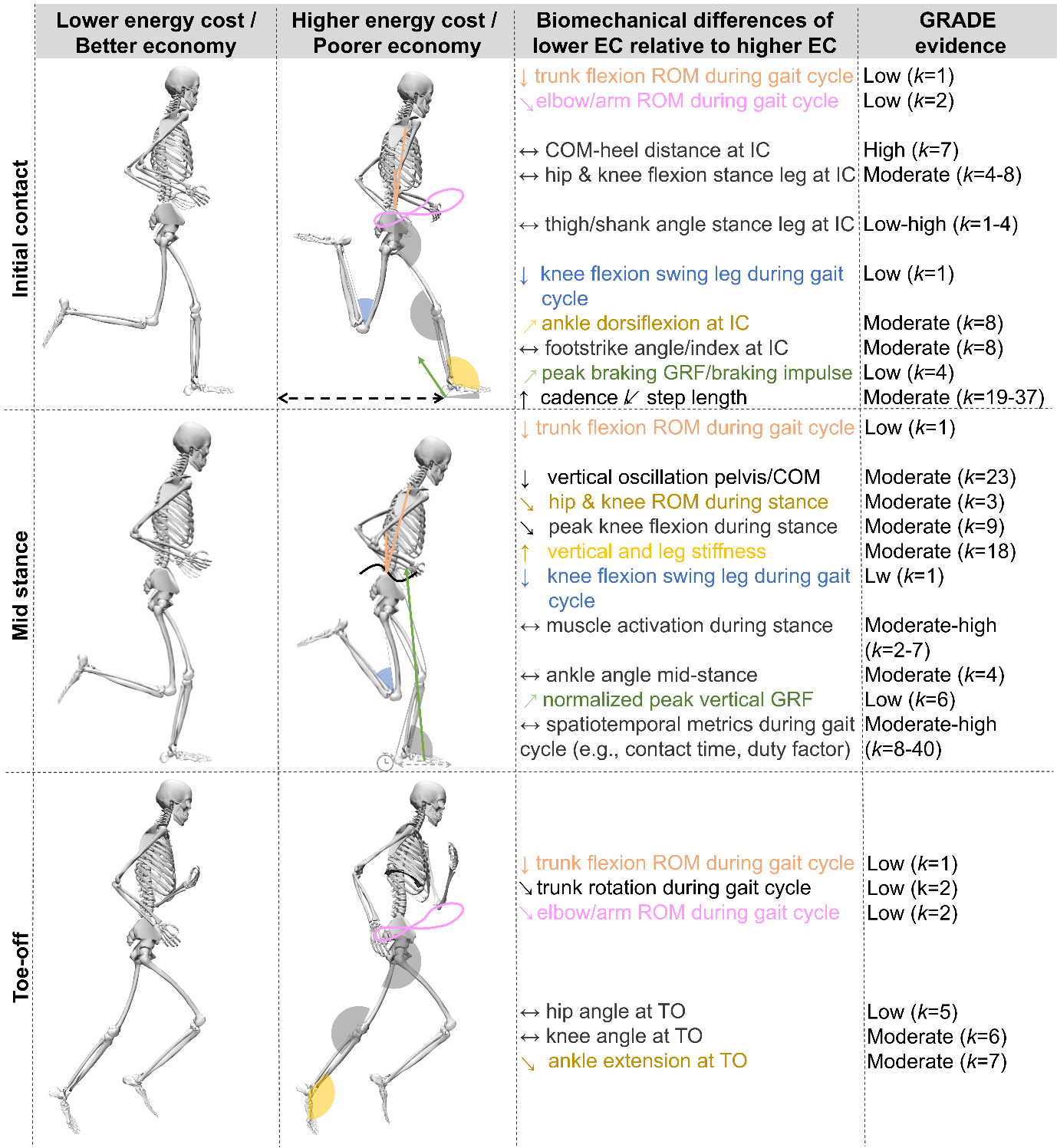 Figure 1. Schematic visualization of the most important associations between running economy and running biomechanics from meta-analyses and individual study results. ↓ or ↑ denote statistically significant correlations, or differences in biomechanics between groups differing in running economy, or differences in running economy between groups differing in running biomechanics, with ↑ indicating more economical runners have larger magnitudes for the specific component. ↔ denotes a component that is not significantly different and of trivial magnitude. Oblique arrows depict non-significant trends of at least a small magnitude (r > 0.1). COM = centre of mass; EC = energy cost; GRF = ground reaction force; IC = initial contact; ROM = range of motion; TO = toe-off k = number of effect sizes for the specific outcome. Figure adopted from (Van Hooren, Jukic, et al., 2024).
Spatiotemporal outcomes
Spatiotemporal outcomes such as ground contact time, flight time, and duty factor showed trivial and non-significant associations with running economy. This is important as these outcomes are often relatively easy to measure by for example wearables. Indeed, several wearables claim to estimate the running economy based on these outcomes. However, our findings show that this approach is not justified by current evidence.
Among the spatiotemporal outcomes, a higher step frequency was however weakly associated with a better running economy. This finding is also in line with the findings of studies showing that most recreational runners often select a step frequency that is below their mathematical optimum. Runners, coaches and wearable technology may therefore slightly increase running economy by having runners adopts a higher step frequency. For example, you can simply use a wearable watch with a metronome that is set 5 or 10 steps/min higher than your self-selected step frequency to increase your self-selected step frequency. Alternatively, you may run to the beat of music that has a beat frequency set 5 or 10 beats/min higher than your self-selected step frequency to increase your step frequency (Brake et al., 2022).
Vertical oscillation
Vertical oscillation refers to the upward and downward movement of your body. A higher vertical oscillation was moderately associated with a higher energy cost (poorer running economy) in the review (Van Hooren, Jukic, et al., 2024). Similarly, a lower stiffness of the leg was moderately associated with a higher energy cost. This means that runners who bend more in their hips, knee, or ankle during the stance phase, and who propel higher into the air during the flight phase have a poorer running economy. While the biomechanical reasons for this are beyond the scope of this blog, there are some important implications to this finding.
First, adopting a higher step frequency can reduce the vertical oscillation, and this is therefore one approach to improve running economy. However, we also observed that the magnitude of knee extensor muscle activation was associated with running economy, albeit non-significantly. Specifically, a higher activation of selected knee extensor muscles was associated with a better running economy, probably because a higher activation ensured a higher stiffness of the legs and thus lower vertical oscillation. This higher stiffness in turn improves the use of elastic energy in tendons and reduced the work that muscles need to produce. It may therefore be worthwhile to focus on exercises that increase knee extensor muscle activation and thereby increase vertical/leg stiffness. Exercises that may be useful to this purpose might include plyometric exercises such as (double legged) bounds (Figure 2) and low hurdle runs, but may also include strength training exercises such as a split step squat.
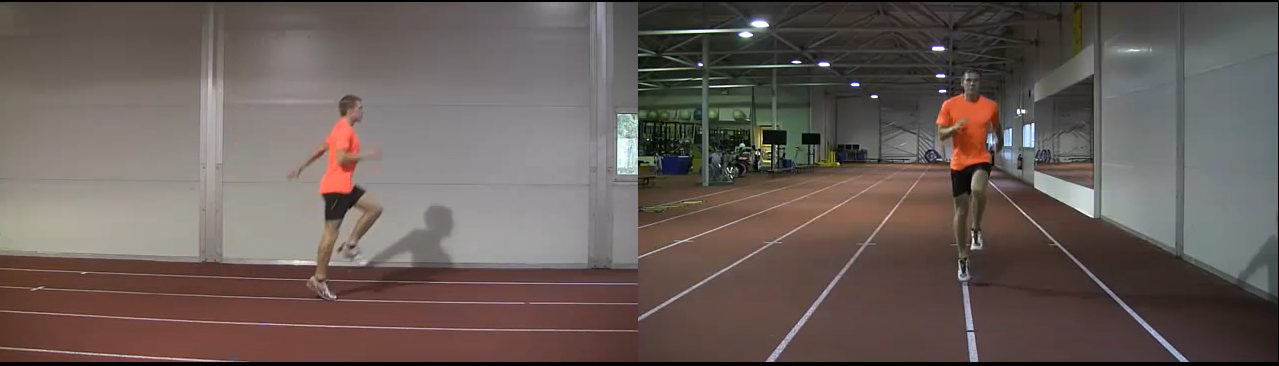 Figure 2. Double-legged bounds. In this exercise, the athlete keeps a short ground contact time and aims to maximize jump height in between the bounds. A short ground contact time can only be achieved by maintaining stiff legs, which in turn requires appropriately timed muscle activation, and it requires sufficient knee and ankle extensor muscle activation. The specific variation shown alternates the left and right legs. Full video available from: https://www.youtube.com/watch?v=MLjNBCGGGUE
Footstrike pattern
Popular books and blogs will often tell you that it is more efficient to land on the front of your foot as opposed to on your heel. We also investigated whether a so-called ‘front-foot or mid-foot strike’ is indeed more economical than a so-called ‘rearfoot strike’. The results of this analysis are shown in Figure 3. As you can see, the difference in running economy between the two footstrikes is only -0.02 units (standard deviations), and it is clearly not significant. Therefore, the current scientific evidence does not support one footstrike type as being more economical than another one!
From a running economy perspective, it is therefore probably not a good idea to change your footstrike pattern. Indeed, one study investigated whether changing footstrike patterns improved running economy over 14 weeks of training, but it did not make runners more efficient (Ekizos et al., 2018).
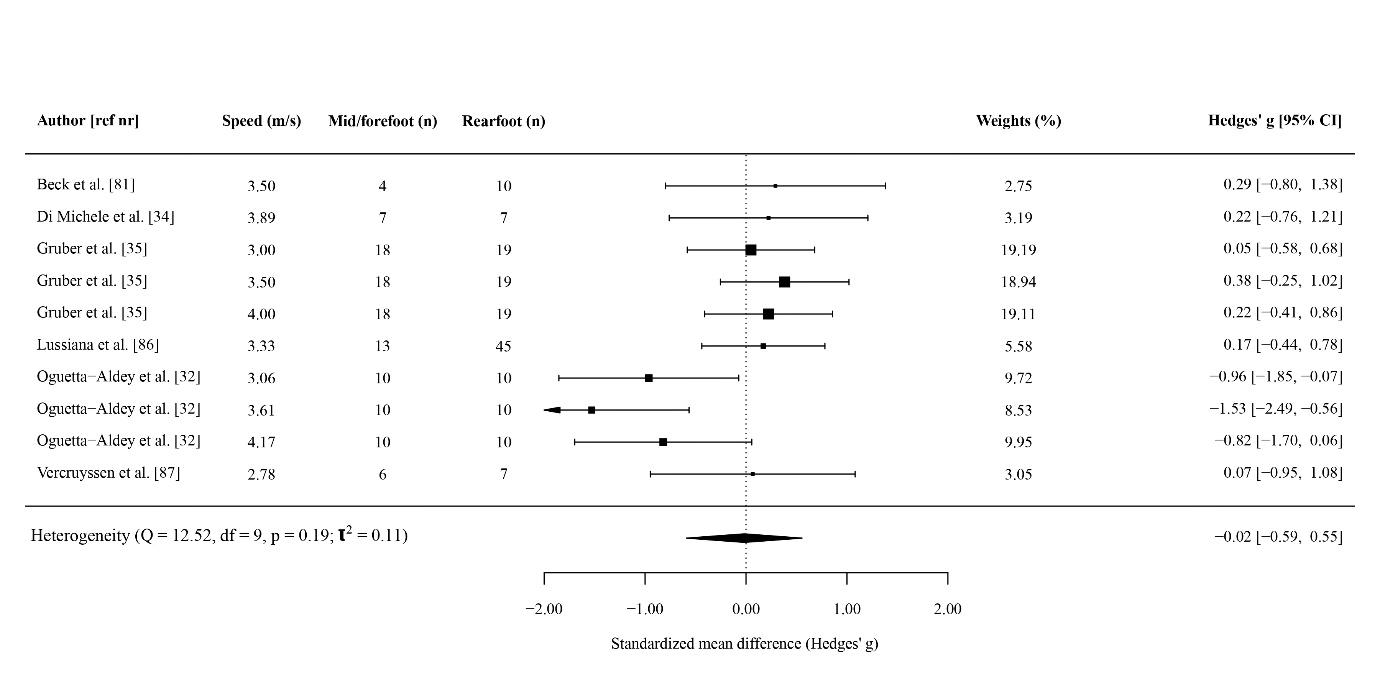 Figure 3. Forest plot from the meta-analysis on the difference in energy cost between a rearfoot and front or midfoot strike. The black diamond on the bottom shows the weighted mean effect over all studies listed higher in the plot, and shows clearly that no footstrike is more economical than the other one. Note also that there is no clear indication that this effect changes with running speed, as the effects do not clearly change with changes in speed.
Running form and running injury risk
Running form is also an important factor in relation to running injury risk (Barton et al., 2016; Ceyssens et al., 2019). However, similar to running economy there are a lot of conflicting findings regarding the technique that best reduces overall injury risk. The sections below will again provide some key findings based on current scientific research.
Step frequency
I previously discussed that adopting a higher step frequency may improve the running economy. With regard to injury risk we also see that adoption of a higher step frequency reduces the load on the most commonly injured locations in runners (Van Hooren, Van Rengs, et al., 2024). In parallel, several studies have associated a lower step frequency with a higher injury risk (Kliethermes et al., 2021; Luedke et al., 2016). Similar to running economy, runners may therefore attempt to reduce injury risk by adopting a higher step frequency, for example using a metronome or by running with music as explained before.
Footstrike pattern
From the discussion before we know that the footstrike pattern is not really relevant for the running economy. For running injury risk we tend to see a similar effect, with no clear differences in injury risk between fore/mid foot strikers or heel strikers. However, the location of the injuries does differ, with more injuries at the knee and shin among heel strikers, and more injuries at the Achilles tendon and foot among forefoot strikers. The current consensus is therefore that you should typically not change your footstrike pattern, except when you have an injury (Anderson et al., 2020; Hamill & Gruber, 2017). For example, if you experience pain at the Achilles tendon and run with a very pronounced forefoot strike, it may be helpful to transition gradually towards a midfoot strike to reduce the load on the Achilles tendon. Similarly, if you experience pain at the knee or shin it could be helpful to transition towards a midfoot strike, although it may actually be more effective to simply increase step frequency as this will automatically result in a more midfoot strike.
Changing of footstrike pattern is something that can be done using wearables that provide real-time feedback on your footstrike pattern, or you could ask someone to make a short video of your running style to check if your conscious modifications had the desired effect.
Conclusion
Running form is an important component of running performance and running injury risk. This blog provided an evidence-based overview of the relationship between selected running form outcomes and running economy, as well as between running form and running injury risk.
References
- Anderson, L. M., Bonanno, D. R., Hart, H. F., & Barton, C. J. (2020). What are the Benefits and Risks Associated with Changing Foot Strike Pattern During Running? A Systematic Review and Meta-analysis of Injury, Running Economy, and Biomechanics. Sports Medicine, 50(5), 885-917. https://doi.org/10.1007/s40279-019-01238-y
- Barton, C. J., Bonanno, D. R., Carr, J., Neal, B. S., Malliaras, P., Franklyn-Miller, A., & Menz, H. B. (2016). Running retraining to treat lower limb injuries: a mixed-methods study of current evidence synthesised with expert opinion. British Journal of Sports Medicine, 50(9), 513-526. https://doi.org/10.1136/bjsports-2015-095278
- Brake, M. t., Stolwijk, N., Staal, B., & Van Hooren, B. (2022). Using beat frequency in music to adjust running cadence in recreational runners: A randomized multiple baseline design. European Journal of Sport Science, 1-10.
- Ceyssens, L., Vanelderen, R., Barton, C., Malliaras, P., & Dingenen, B. (2019). Biomechanical Risk Factors Associated with Running-Related Injuries: A Systematic Review. Sports Medicine, 49(7), 1095-1115. https://doi.org/10.1007/s40279-019-01110-z
- Ekizos, A., Santuz, A., & Arampatzis, A. (2018). Short- and long-term effects of altered point of ground reaction force application on human running energetics. Journal of Experimental Biology, 221(Pt 15), jeb.176719. https://doi.org/10.1242/jeb.176719
- Folland, J. P., Allen, S. J., Black, M. I., Handsaker, J. C., & Forrester, S. E. (2017). Running Technique is an Important Component of Running Economy and Performance. Medicine and Science in Sports and Exercise, 49(7), 1412-1423. https://doi.org/10.1249/MSS.0000000000001245
- Hamill, J., & Gruber, A. H. (2017). Is changing footstrike pattern beneficial to runners? Journal of Sport and Health Science, 6(2), 146-153. https://doi.org/10.1016/j.jshs.2017.02.004
- Kliethermes, S. A., Stiffler-Joachim, M. R., Wille, C. M., Sanfilippo, J. L., Zavala, P., & Heiderscheit, B. C. (2021). Lower step rate is associated with a higher risk of bone stress injury: a prospective study of collegiate cross country runners. British Journal of Sports Medicine, 55(15), 851-856.
- Luedke, L. E., Heiderscheit, B. C., Williams, D. S., & Rauh, M. J. (2016). Influence of Step Rate on Shin Injury and Anterior Knee Pain in High School Runners. Medicine and Science in Sports and Exercise, 48(7), 1244-1250. https://doi.org/10.1249/MSS.0000000000000890
- Van Hooren, B., Jukic, I., Frenken, K., Cox, M., Bautista, I. J., & Moore, I. S. (2024). The association between running technique and running economy: A systematic review of observational studies. Sports Medicine, Epub Ahead of print (1).
- Van Hooren, B., Van Rengs, L., & Meijer, K. (2024). Per-step and cumulative load at three common running injury locations: the effect of speed, surface gradient and cadence. Scandinavian Journal of Medicine and Science in Sports, 34(2), e14570.